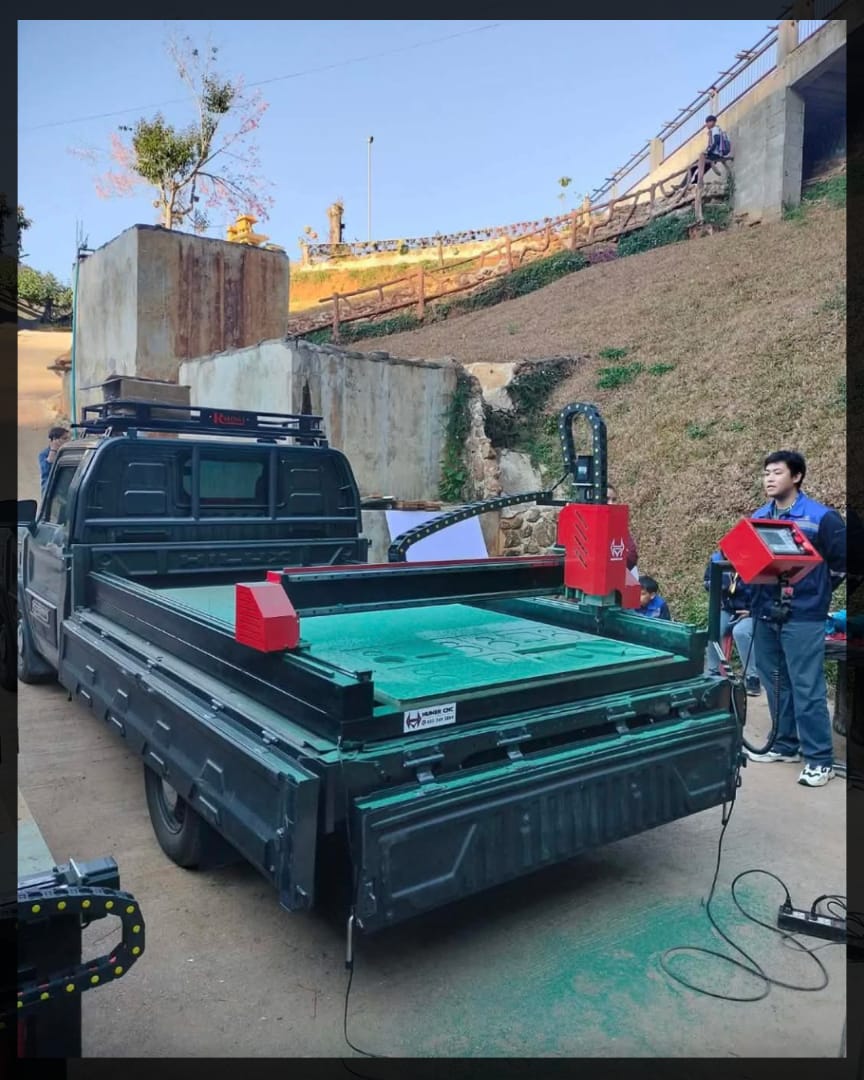
Hi I’m sorry to bother you. First of all you need to understand I have had four strokes so I can’t read write and speak properly. It’s a little bit annoying.
I have been going through your forum trying to find this question and I have an I’m very sorry if it’s there.
I want to build a CNC that is 2.5 X 9 metres. I’m building a catamaran and it’d be really useful if I can cut the foam and glass before I put them together.
I was a mechanical engineering so I can figure it out but if I can build it using your system or one of the others then I can use it but the 2.5m is much longer than the one you show. 1.2m is good but it’s not big enough. Has anybody tried building it longer ? Otherwise I looked at your L2 and use 4 X 1" rather than two to make it stronger.
Anyway I thought I would ask. Thank you for reading.
No idea. Curious to see what others think, and what you get up to…
Sounds like an epically large customized lowrider 4 build would be needed for such an epic project. Curious what Mech Eng folks here think about such long Y belts using the stock LR4 design?
I’m not a Mech Eng, but I think the bigger challenge would be the X axis span.
Stretch in a set of 9m (almost 30’) belts probably isn’t trivial, and there would probably be a lot of sag, even if tensioning them somewhat tighter than normal. However the issues of mass, sag, and loss of rigidity in a 2.5m (8.2’) gantry would likely be more challenging (Note that 2.5m is probably the desired cutting area, so the gantry would likely be even longer). It is effectively doubling the length of a normal gantry.
Again, I’m not an Engineer, and I certainly didn’t design the LR4 or do any calculations on its limits, but I suspect that these dimensions are just too much for the LowRider to handle effectively.
Yeah, that’s a good point. My comments re: mass, sag and rigidity assumed a router. Using a drag knife, laser or lightweight cutting tool might make the project viable.
That’s an even better point. Presumably the catamaran would be built from smaller components assembled together, so a full 2.5m x 9m CNC may not be needed, and a more practical 1.5m x 3m build might be appropriate (again, assuming use of a router for cutting).
Have been wondering whether OP wants full 2.5m x 9m CNC laser setup to cut/mark their sail(s)? DIY’n a sturdy sail would be neat given how many boat bucks they normally cost (per an upset friend). Would need seriously heavy duty stitching machine though, unless… you figure out a way to laser the holes (while also mildly melting fabric to eliminate fraying) as part of the contour and cutout fabrication…
Adding #mostly-printed-cnc’d-jank-af-tarp-yacht to my project list
I can design it I can build it that’s not the problem I just thought if somebody else has done it that means I don’t have to do it again that’s all. I spent 40 years designing and building laboratory equipment and factories and all sorts of things I can build whatever I need to but I’m old I’m blind I can’t read and write properly so I just thought maybe somebody else has already done it sorted out and I can just do it that way that’s all. I haven’t fiddled with those belts. That I have not fiddled with before so I don’t know how strong they are. The rest is easy. The only reason I looked at that it’s because getting a screw that 9 meters is a bit tricky I can make one but it’s an annoying job.
I take it “glass” is glass fibre, applied to foam forms, and it js the foam that is actually being CNC cut.
I might suggest that using the CNC to make templates in sections which can be joined together like a jigsaw puzzle might be more efficient, and doesn’t require more room than any single room in my entire house, including garage. This also results in a machine that will be more capable for doing other things than the hull, like decking, fittings, seats and cabinets, for which the as-designed size is entirely adequate. Once you have templates, the foam can be cut with a hotwire with a lot less mess and debris than a router will generate.
Now if you are considering.doing a full 3D sculpting of the foam core before laying glass fibre, that may be a different matter, but keep in mind thst the LR4 has a Z dimension, typically limited to about 100mm. Taller Z carves will require specialized router bits and some accommodation of the gantry. (The LR2 was the last one that this extension was relatively trivial for.)
In any case, I would be far more likely to make the foam cores in pieces and glue them together. There is a small weight penalty there but the strength ultimately comes from the glass fibre around the foam, so that part should be perfectly fine.
I’d put money on companies that build these thjngs using templates that come apart for storage, and/or making the foam cores in sections.
I can make it in small parts but that is a lot of work. My plan was to make the foam two meters by 9 meters with glass and vacuum with the large 2*9 m I can cut the sides and everything in it. The machine can do all the cutting. I also have to cut up some 8*4 ft MDF as the template to put it all together. The bottom of the how is glass and epoxy and no foam from the bottom up to a lip so I need to make a mold to do that. I know how to make all the parts it’s just that they take a really long time if you’re doing it on your own you just have to work a long time to make each of the parts that’s all and I have to go through it on the computer anyway to make sure everything will fit.
Anyway thank you very much for your comment. If it hasn’t been done easily then I’ll just designed it and do it myself it’s all good it’s just a lot of work to build a screw that nine milimeters wide. Obviously I have a lathe it’s not a huge one but it’s big enough to do the job it just did it takes time. If the belt isn’t strong enough to run 9 meters then I’ll just have to use a different system, that is the one that I not sure about because I haven’t used that stuff before I’ve got a bit of it but it doesn’t have the steel belts through it it’s just one for very light work so I assume the others are stronger but I don’t know how much.
I wll give you a cheap tip: you can get 50100 tslot extrusion fairly cheap (on Amazon)
It wont be as stiff as 80160 but could sit you well. The other parts you can run a basic workbee/oc cnx from openbuilds with vheels and the makerstore plastic pinion rack . You will need a lot of cbeams for both y axis rails

 project list