Shoot we already have some in the bom! Datasheet - LCSC Electronics
Yeah, for sure, but even then that’s not that simple. We’re going from open circuit to short circuit, which is a big shift in impedance which means the circuit has 2 distinct states, rather than a driven output with a known impedance, etc. The speed is definitely easier, but everything else is harder. You’d simply not try to do this if it needed to be GHz, for instance, you’d be using transformer isolation, specific transceivers, encoding patterns for noise resistance etc.
Apologies if I gave any indication that I was offended in any way, zero of the above was meant in that tone at all! That comment was meant to more be a gentle nudge to consider what those things actually mean and bring a little more precision into the discussion precisely because I think it’ll help with your understanding, as well as making it easier for me to see where there are concepts that it might be worth me taking some time to explain further.
Yeah, for sure, and that’s exactly it. I’m always happy to spend whatever time is needed to understand a topic, but via text it’s hard to do in a way that I feel is sufficiently precise, hence why I end up writing so much! I tend to start being aware I’ve spent 2 hours in a response and hurrying through, which doesn’t help.
That’s great, but it is prone to becoming bait for me to provide corrections!  Like saying the diode ‘wastes power’ makes it seem like you’re worried about the higher forward voltage of a different diode being wasteful, vs other considerations.
Some of that is definitely my mistake for maybe not clarifying enough or taking enough of a step back sometimes. You’re where you’re at and it’s on me to try to aim for building on that, but questions if you’re not sure about something are the best way for that to happen. If there’s something you spot and go ‘Huh, what does that mean…’ then ask and I’ll explain in whatever way is needed to get it across. Definitely don’t spend too much effort trying to decipher my ramblings if they’re not clear up front.
I probably should have been more blunt, then. I don’t want to sound discouraging, because a lot of this stuff isn’t rocket science, but that input is about as basic/brittle as it gets. I’d be nervous using it in any capacity that interfaces to the outside world, let alone one with static risks and being connected to unknown equipment. But, as previously mentioned, I’m moderately paranoid about things like that.
Yeah, and that’s kinda the problem with most open source hardware. Honestly, the vast majority of it is just kinda shitty. Same thing with almost any hardware intended for DIYers etc. That’s not necessarily a bad thing, it’s just not getting the design time and rigor putting into it that a commercial product would and it gets away with a lot because something dies and people tend to assume they killed it, not that the product was faulty or not fit for purpose.
Yeah, that’s a bit weird and I don’t have a good answer other than man, statistics can really bite you.
I really dunno. I think protecting at the board is a better option, this seems to me to be more of a bandaid, but the nice thing is that it would work with existing boards. I’m still quite concerned, personally, about the homing switches but I think them being less likely to be touched along with being wired NC is saving us there because any ESD strikes at the switch end will effectively be common-mode, meaning that the current flows via both ground and the input, so there’s no voltage difference (or less of one) at the jackpot board itself. Under that condition, making an anti-static probe doesn’t seem like a terrible option, really.
Yeah, that looks reasonable. In terms of placement, you really want the trace to run through the pad of the TVS, so it goes connector to TVS pad and then onwards, don’t have the trace ‘tee off’ to get to the pad.
Those are bi-directional ones. I wouldn’t personally go for those here because they will only help you with one polarity and static can easily be either. A unidirectional TVS will clamp one polarity acting as a diode, say to 1-2V ish, then will act as a zener in the other direction, clamping to ~30-40V depending on how much current there is. A bidirectional one is basically 2 unidirectional ones back to back, so it’ll clamp to 30-40V in either direction, so a negative strike relative to your 0V will look like -40V applied, which will all end up going through the BAT54S and likely kill it with current.
If it were me, I think I’d change it so that you’re using a single diode instead of the array. Let the TVS handle the negative voltage/current condition.
so if it is just this, why not put the additional in the PROBE lines, instead of the board, maybe when it comes time for a new revision do it then
That makes a few assumptions, like that it’s a strike on the probe that’s causing the issue. It could also be that the probe connection is handled later in the piece or more people are poking at that part of the board. It could be the strike going through the cable, even a 300V cable insulation won’t stand up to a decent ESD strike, it’s just usually not enough discharge current to cause it to be able to be felt but it’ll still hurt stuff.
It also needs to be between 0V and the input, so if it were in the probe it’d need to have the ground clamp go back to the probe, ideally. It also wouldn’t protect you anywhere near as well if the ground clamp wasn’t connected yet and the ESD strike occurred at the probe relative to the installation earth, or if there was another earth return that was lower inductance, etc.
So in terms of reliability that it’ll actually protect you its:
Good:
TVS on the jackpot
Ok:
TVS on an adapter board at the jackpot pins
TVS on a adapter somewhere near the jackpot
Maybe ok:
TVS on the probe with a separate 0V clamp coming off the probe
Probably won’t do much:
TVS on the probe with its own 0V return and the clamp coming off the jackpot
1 Like
I can change the instructions and the tool mount so the clamp and touch plate sit connected. So if anyone that goes to touch them it has a path to ground, they would only be disconnected while in use.
Now that I look at it, the LR3 had the touchplate this way. Both ends are touching the stepper body, so maybe we did not see any on that one for that simple reason. Any static from the person had a path to ground before they removed it.
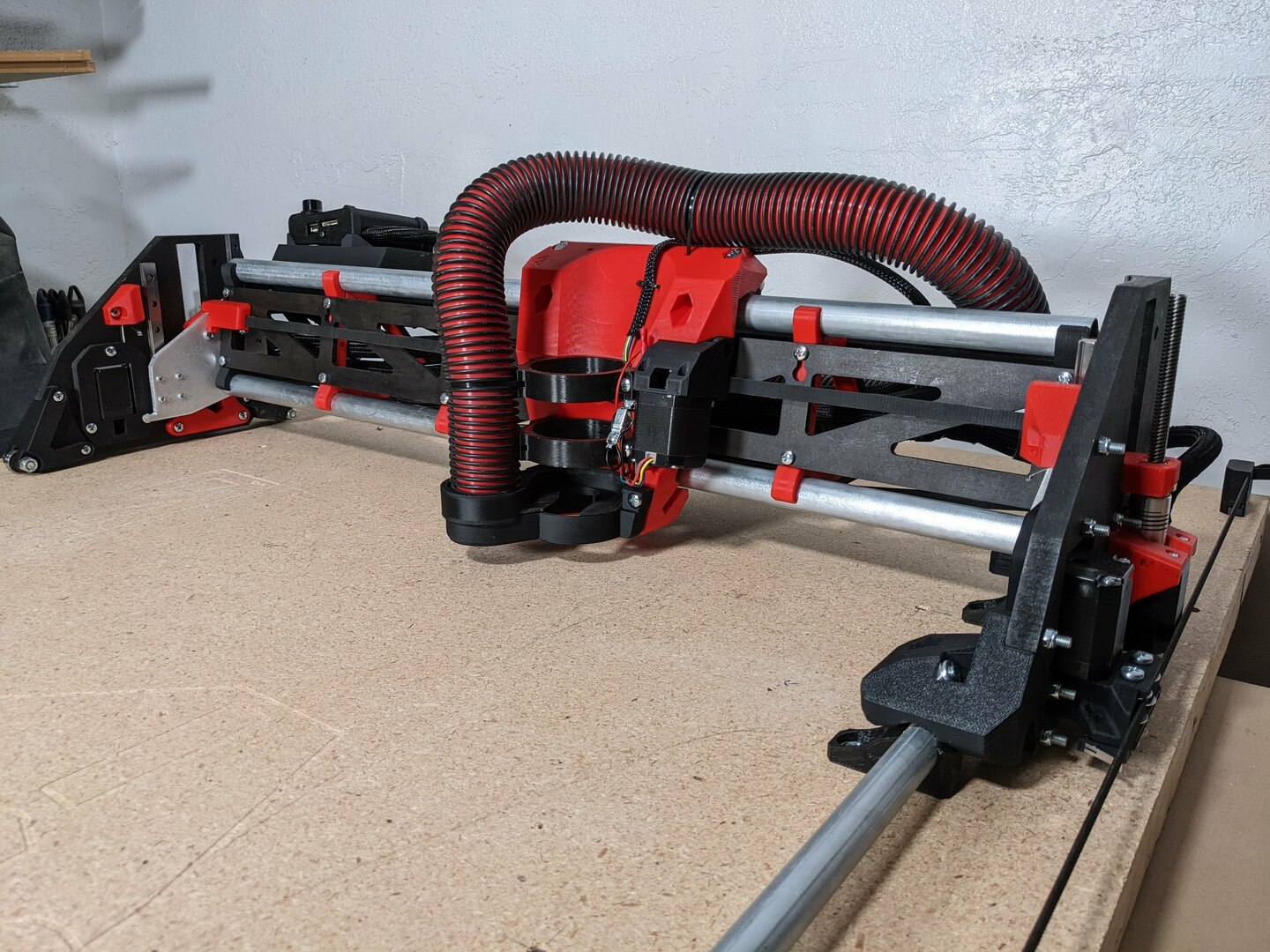
This sounds good. TVS on the input and a single diode instead of the bat54s. If you have any pointers on this one I bet we already have a few candidates in the bom already.
It’s always bugged me that the documented way to run the probe (and X endstop, and stepper) wiring is without a shield overbraid and tied to the one component on the machine most likely to develop a significant charge (the vacuum hose!).
I think shorting the probe when not in use would be a good thing- provided it doesn’t freak out FluidNC during operation.
Well that does sound pretty bad all laid out like that. I will add it to the to-do list.
1 Like
These are the TVS on the USB port, Sounds like I should switch them as well. That also keeps the BOM smaller and we all know I love that.
Maybe just arrangements to short the probe and finding a twisted, shielded wire for the probe wiring would be the next step on the machine side of things. Further hardening the inputs, which youre discussing, also seems reasonable.
The shield on the probe wire would possibly help if it’s charge from the hose, provided the shield is grounded. As noted above, the endstop is NC which shorts the circuit most of the time, and the steppers are only around a couple of ohms- so those are less likely to get charged up.
If we are going to shield them I am going to try and find a cover for all of them. That seems the best option, if there is something easy. Otherwise, there is still the x endstop, stepper wires and the probe.
I’m less convinced that shielding is a good idea. It depends more on where the discharge is occurring. I think there are a lot of misunderstandings out there about how and when shielding makes sense. I used it for everything when I wired up my MPCNC but I’m far from convinced it was worth it over just a standard overmoulded multi-core cable.
Basically if you’ve got a metallic enclosure already, shielding is great as it extends the enclosure. This is where you’ll see plugs with metallic housings, wrap-around connection fingers and a cable braid clamp that connects to the shell over the full 360 degrees.
If you’ve got an open PCB at the far end, it doesn’t help anywhere near as much because that becomes the source/origin of any noise, same thing with the ESD. It’ll avoid a strike directly into the cable, but I doubt that’s a primary point.
It also adds a lot of wiring complexity, cost and annoyance to work with. I’d much rather see cheaper cables used and a further few $ spent on filtering/ESD suppression at the board level. Especially because there’s nothing that’s particularly unknown, here. We’re not dealing with high frequency signals so there’s no worries about the junction capacitance of a large TVS or an aggressive filter, etc.
I don’t think it’ll hurt, I’m just far from convinced it’ll help enough to be worth the expense/effort vs more deliberate/direct methods.
Agreed. I don’t think this is coming from people handling the probe by hand. It certainly could be that, as the probe gets handled all the time.
When I hear of folks killing two pins in the span of a week or two, I think it’s more a situation like mine.
In many environments, dust collections isn’t a big concern, but in an environment like mine where it’s regularly very dry the dust collection charging is unbelievable. I’ve darn near knocked myself out on one of my early cyclone extractor buckets- biggest zap I’ve received since I stopped working with flyback transformers nearly 30 years ago. I got some good ones just reaching around the hose, too- before I stopped using the shop vac hose as a “temporary” measure. That’s one reason the LR4 in my garage is apart right now- looking to beef up my own dust collection grounding.
When it’s dry here even the ‘regular’ ESD events are not the lower end of the human body model, not the 2kV or 4kV stuff. It’s a good blasting.
Harden the inputs, improve the probe so it’s got either a short or a small resistance across it when stowed are probably the two best steps to take.
The thing is, if shielded cable helped with that situation then so would a drain wire. In fact, the better solution in that case may well be to bundle an uninsulated drain in with the bundle.
I kinda think that part of the issue here is that this is all speculative. We all have our pet theories as to why this is occurring. If we’re wrong, some of these still work, others don’t.
A TVS at the Jackpot works, regardless of ESD source, it’s just a case of sizing it. Shielded cable or drain wires or whatever else work for some situations, not others, and likely at significantly higher cost, albeit an easier retrofit.
If someone is reliably killing Jackpots then getting them to re-route a cable or replace it with a shielded one to see if that fixes it is a good step. Otherwise, I don’t see the value, personally.
1 Like
Great point.
Also a great point.
@vicious1 - have you kept a tally of failures you’re seeing by type? I’m really curious to map it back and get it out of the realm of Jim’s crazy theory and look at some failure statistics.
Yes, this should get added no matter what. It’s a great improvement.
1 Like
To implement this sounds very inexpensive. The easiest way would be a bare wire to ground right, I will amend my notes.
For now, I am only counting the ones I get back and test myself, but am paying attention to forum posts about others. I am not at the shop right now but I have only fixed the one set of inputs no others have tested bad out of the box…but I did have a batch of JP1’s with about 50 total bat54s that were bad on delivery, I fixed and shipped them…so I am eager to figure out this new input, working on it now.
As for the bad “B” port, I have 3 in the shop. So far the one is actually a bad “C” port possibly the driver not the multiplexer, so this is so far very inconclusive. I have not checked the others yet I spent all the time on the inputs on Saturday.
All the rest are forum reports.
Yeah, just a bare wire routed with the cables. I don’t think it’ll necessarily help that much, certainly not enough to avoid needing a TVS or something, but it’d be worth testing. I think it’d be a more cost effective way to get a similar level of protection to a shielded cable, which I’m not convinced is all that much in this specific case.
1 Like
Okay so I am not understanding the unidirectional versus bidirectional. We need to protect against positive and negative ESD. So when a spec sheet reads reverse standoff and breakdown voltage I have to read those as a negative and positive value? 1 hour yesterday and 2.5 hours this morning and I swear it just gets more confusing.
Datasheet - LCSC Electronics, so this will let through +/- (2-3.6v) and we can’t handle the negative side of that. Otherwise, this thing looks perfect, the esp32 inputs are 2.5v-3.6v
I found a good paper, finally, https://www.ti.com/lit/an/slvae37/slvae37.pdf?ts=1772345508988 starting to get it.
1 Like
Okay smart guys, I thought I was crazy and going around in circles. I just discovered why some have a much higher Vbr than Vclamp. Snapback TVS diodes. So my question is on the snapback is the Vclamp still the highest voltage the circuit will see (AI says that is true…but…)??
If so I can get a TVs with a 3.3V Vrwm and a 3.6V Vclamp, with 15-30kv protection, is this the perfect solution?
Datasheet - LCSC Electronics the issue I see with these is they have a 2.3V clamp, after the 3.6V breakdown, which is under the 2.4v esp32 trigger threshold, but if we have an esd even to trigger them who really cares what the holding voltage is right, after the shock they will reset? During normal use they are 3.3V Vrwm. This chip protects against 15kv, 4 channel, $0.12/each, we will need 2.
1 Like
Yes. Unidirectional behaves like a zener diode. In the forward direction it’s just a diode with a fairly crappy Vf. In the reverse direction it blocks any current from flowing until it gets to a certain voltage and then starts to go into breakdown where it conducts. So if you have something like a power supply input where it can go from 0V to 24V but would be damaged outside that range then you would use a unidirectional one. The forward conduction protects against negative voltages, the breakdown above 24V protects against positive ones. On the other hand, if you have an input that can go +/- or need to provide protection between two lines such as CAN or RS485, you’d use a bi-directional one so that if one line gets pulled high or the other gets pulled low, it’ll clamp to limit how ‘far apart’ they can get, which is one of the things that can damage a transceiver. In some cases you can also make your own combinations, such as for protecting MOSFET gates on power supplies where you want to limit the voltage to within the range of -5V and +20V. In that case you might use a ‘reverse’ connected 4V zener in series with an 18V zener.
An ideal zener would have a sharp transition from blocking to conducting and it would then stay at that transition voltage no matter how much current flows. In reality, they slowly start to conduct up until a certain test current which is where the voltage is specified and then any more current than that and the voltage starts to rise.
In terms of the nomenclature, each of those voltage points is just what you get with a different test current.
Standoff voltage is the voltage that the TVS is intended to be used with. So for protecting a 24V line you’d use start by considering 24V standoff TVS. This will just be based on some test current spec like at 24V the TVS won’t be conducting more than 10uA or something. Basically this is the voltage at which it won’t have too much effect on the circuit.
Breakdown voltage is where the TVS will start to conduct, but weakly. Usually this is tested at 1mA of current through but might be 10mA with lower voltage parts. At this voltage you’re starting to get some level of circuit effect but not really any protection.
Clamping voltage and current is where the TVS is operating at the rated pulse power, which is usually also coupled with a test waveform, such as the 10/1000 waveform which means a linear ramp from 0A up to Iclamp over 10us and then a ramp down to 50% of that by the 1000us point.
You gotta ask some questions or ask for some explanation, man!
So for a start, that’s a 2V device so I wouldn’t want to use it beyond that without any careful design. At 3,3V typically it’ll be conducting already, passing 1mA. Note that this is a typical number, the minimum WILL be lower, so it may be that it starts conducting at 3.0V in which case by 3.3V it’ll be conducting maybe 5-10mA.
My gut feel from looking at the size of the device is also that it’s intended for incidental ESD strikes that are likely through a relatively high impedance connection and won’t be repeated all that often. There’s a reason why it’s specified to 10 total pulses.
Another thing is: are you ok with those inputs being hard limited to 3.3V? At the moment, they can be used with any voltage up to the breakdown rating of the diode array, if you add that TVS on the input connector side you’ll limit that to 3.3V. If you add it between the diode array and the ESP32 then you’re still gonna see dead diode arrays.
The TI reference material is great. I’d say not to spend too much time in the detail, though, app notes like that may not be a great fit for what you’re trying to achieve and can easily pile in a ton of complexity because they’re assuming someone is starting from a different point, i.e. tighter, defined spec, trying to comply with existing standards, other previous design decisions that haven’t put them on a specific path, etc.
I have never worked with these but in general I’d advise to stay away from anything that has a negative part of the impedance curve. That is to say it conducts more over time or starts to conduct and then drops back. Gas discharge tubes do this and it can cause issues. You need to make sure that they will always, always release once the strike has passed, otherwise they get ‘stuck’, which usually causes them to overheat and burn out. I don’t know how much that’s an issue for TVSs but I assume it’d be the same. It’s a good way to remove margin, but you don’t need to.
Let’s take a step back, why are you trying to protect to 3.6V? Are you ok with these being ONLY 3.3V inputs? No connecting it to 5V, 12V, 24V etc.?
Will they? If they’re connected to a driven output at 3.3V then they would never reset and you’d either damage them or damage what they’re connected to. If they’re only being pulled up to 3.3V then they probably would but it’s hard to say.
Personally, I don’t see the need for a TVS with snap-back and I’d personally avoid using one like the plague without quite a lot of design effort and testing. They’re useful for protecting very sensitive inputs but these really aren’t that sensitive.
Oh man, I can’t believe I got that 3.3v stuck in my head. I was looking up the esp32 and going to work backwards but went straight to the tvs…Shoot.
It should be a little easier to work with a full range input, although I am not sure if we will ever need it or if anyone ever used more than 3.3v, but it is more safe.