Lowrider V4

Hi V1E community!

I’m Zayden, a high school sophomore who recently got a Lowrider V4 (huge thanks to the awesome guys at RMRRF!). I’m setting it up in a small workshop I’m building out of a repurposed playhouse/shed my dad built for my brother and me, so space is pretty limited.

Because of that, I’m planning to mount the machine so it can fold up against the wall. I have a mechanism in mind and will probably make a separate post about that later.

I’m really excited to get started, but I have a few CNC questions since this is a new world for me (I’ve got experience with 3D printing, but CNC is brand new).

Questions:

  • I have an older DeWalt shop vac—will that work well for dust collection on the LR4? If so, what hose setup do people recommend? I heard I needed a grounded one but don’t know what to purchase.
  • I saw “Project Cookiemonster” which used the hidden belt mod—how worthwhile is it, and how difficult is it for a first build?
    • If I do the belt mod, should I build it into the initial assembly or run the machine stock first and modify later?
  • Would you recommend the 1/8" end mill variety pack from the V1E shop for a beginner doing general-purpose work or should I purchase individual bits as I need them?
  • Is building a torsion box table worth it for this machine? If so:
    • What materials work best?
    • Is Home Depot plywood good enough, or should I source better stock?
    • For building the torsion box itself, is it practical to assemble the LR4 temporarily on sawhorses and a sheet of plywood to cut its own table parts? If so, how do you handle belt length/accuracy during that setup?
  • How well do the printed PLA parts hold up in heat? My shed can get pretty hot in summer and is uninsulated.
  • Any recommendations for sourcing inexpensive 2–3mm aluminum sheet stock for light machining?

Thanks for taking the time to read this—I really appreciate any advice. I’m excited to get this machine going and expand what I can build with it!
1 Like

Yes, absolutely. I think shop vac is even better than a big dust collection because of the higher velocity. Use a cyclone with it so you don’t always have to empty the vac’s filter.

I wouldn’t if you don’t have any experience.

Yes.

You could put a sheet on the floor and call it done, since you are planing it anyway. I personally would recommend a torsion box though.

They are good until 50 or 60°C, after that it gets problematic.

2 Likes

Awesome, welcome to the community! Good to see people get into this journey so young.

I made Project Cookie Monster, and while I recommend the the hidden belt mod made by @DougJoseph and isn’t that difficult - it is another whole procedure and complication and can be fiddly. I would first get it up and running, and then go back to make the upgrade if you need it. Just give yourself the table space to move it out if you need it later.

V1E end mill pack is a no brainer, it’s what you need to start, affordable, and gets you going. Not to mention supporting the inventor.

Torsion box depends on how big you want to make it. There are may posts you can read through here on the topic. It can never hurt, but isn’t absolutely necessary. MDF is the preferred table top material, it’s flat and dimensionally stable.

Haven’t gone through a summer, but mine has so far been very good. Others have assured me that theirs have went through the summer heat without issue.

Haven’t started metalwork on the machine, but there are generally local machining sources you can pick up stock.

Shop vac is good, start with what you have and only upgrade if you need to.

Lots of good questions to start, keep them coming1

2 Likes

Awesome, thank you! I was planning on making it cut a full sheet, so I think I will probably make a torsion box table then.

For extra space, which dimension do I need to leave space in, and how much?

Should I construct the rest of the box out of this, or should I make the ribs out of plywood for weight reduction since this is going to fold up? Additionally, should I add an extra layer of MDF on the top for spoilboard?

Which hose should I get, does 2.5” x20’ sound good, and does it need to be grounded? Would something like this work?

That’s awesome!

I would skip that. Mods can be a slippery slope. Best to start with as designed.

Yes. I’d also pick up some extra 1/8 single flute upcut endmills since that’s the most common one to use.

You could use plywood, MDF, or OSB. You definitely want the spoilboard to be MDF.

That’s basically the same hose I have.

1 Like

You would have to move the whole unit to the min side (usually left) to hang the unistrut. You could start with a 2x4 and then replace it as another option.

Spoil boards are good.

MDF is good, but heavy. If it needs to fold up you will want to read up and find the right answer on table for you. Can make anything work, it comes to time/money/size/weight/mobility etc.

1 Like

For the MDF spoilboard, should I cut it in sections before screwing it into the topboard and planeing it so that I can replace only worn sections? It seems like a lot of screws would have to be taken out and replaced to replace the whole board at once. If so, how many sections should I cut it into for the standard size sheet?

Hello again, Zayden. I’m Jim, and I’m the other sponsor of that LR4 Ryan sent to you. I’m super happy to know that the demo machine is going to a good home.

I see @Tokoloshe has answered most of this above, so I’ll add only a couple of notes.

I’ll be blunt, with a disclaimer.
Blunt: The mod makes the machine less capable. It adds lever arms that will make the machine performance overall less than without this mod. The machine is very capable, so that doesn’t ruin performance- but it’s my opinion that the pain isn’t worth it to hide the belts. I’d rather have the better machine performance. It may also not be compatible with future improvements to the LR4.

Disclaimer: For some folks, hiding the belts is visually better. I understand OCD at work as I fight my own OCD in other ways- so no offence is intended to those who use this family of mods.

Yes I would. You’ll have a bit of a learning curve, so plan to go through a few before you get comfortable using the machine.

Worth it? Heck, yes.
Needed to start? No.
I’d say get your machine running on whatever surface you can, then use that to start upgrading your machine. You saw it on a dead-simple pair of sawhorses and Melamine at RMRRF, but some folks even set these on a bare floor on MDF and use that to start making parts for the machine.

You can use it, but to be frank: That stuff is junk. For a torsion box, consider something even simpler: OSB.

See if you can find a good quality wood supplier near you for projects where you care about how the work looks.

Not only practical, preferred.

You lay out the belts on the table, follow the build instructions for squaring the machine, and stop worrying about it. The machine is better than needed for this to work very well.

My unconditioned garage in Colorado sees something like -10F to 110F temps inside through the year. ( -23C to 43C). In three years of this, no issues. If your space is any hotter than that, there are options but maybe a better thing to do would be to get a good attic fan for your space. Who wants to work in 110F plus temps?

Please post build pictures and projects here. We love to see community members making progress (or even talking about setbacks.)

Welcome to the community!

5 Likes

Awesome, thanks so much! I was only planning to do the mod so that I don’t bump or mess up the belts when loading the machine, but I see now that it is not necessary. I can’t wait to get this thing up and running, I will post updates here as I go. I would also like to film the process depending on how much time I have, so I will add the video links as well. Thank you all for all the help!

3 Likes

Honestly I don’t think so. By what you need. 99% of the time I use single flute upcut bits. If you carve you need v-bits, and or ball nose. I don’t carve often.

You can pull a wire through any hose you have and ground it on one end., no need to spand any extra.

I would wait on metal for a little while. Foam, then wood, then plastic. Once you can mill plastic easily, metal is much easier. It can be very frustrating to start there, and thin stuff presents it’s own unique issues.


Welcome to the Crew!! Jim and I are excited about the talents that got you to the show in the first place, seeing what comes of a CNC in your hands is going to be fun.

My biggest tip, don’t overthink anything. You can change things later, if something breaks it is easy and cheap to fix, just get it running and making a mess and all the rest will start to answer itself as you use it.

3 Likes

Welcome! You might consider purchasing some really cheap 1/8” upcut mills from amazon. 10 of them for $12-$15 or so means you can cook a few getting accustomed to the system before you commit to using one of the good ones Ryan sells. You can also get small aluminum plates there as well. As was suggested earlier, save that until you are more familiar with your system.

Running on sheet of plywood mounted to an old door can work great. As can having a vacuum table with drop section and grooved track for workpiece clamps and a color coordinated pendant. You really have 2 options here as you get set up: You can make the cnc and upgrades the project or you can make projects with the cnc. What will be your first cut?

Sounds like a good idea to get started, I’ll do that and buy the quality ones once I’m sure I won’t immediately break them.

Not sure yet, but I was planning on making some cuts for my torsion box table. Do you guys recommend doing it by cutting strips with a table saw and gluing them together or should I set up my cnc and make something with interlocking grooves like this?

Either works the same in the end. The CNC version assembles a little easier, but takes more work up front.

I suggest just getting it running something like we had at RMRRF, do some other cuts, some carves, some little projects, the strut plates. Small projects before you dive into a giant project like a table and table stand.

1 Like

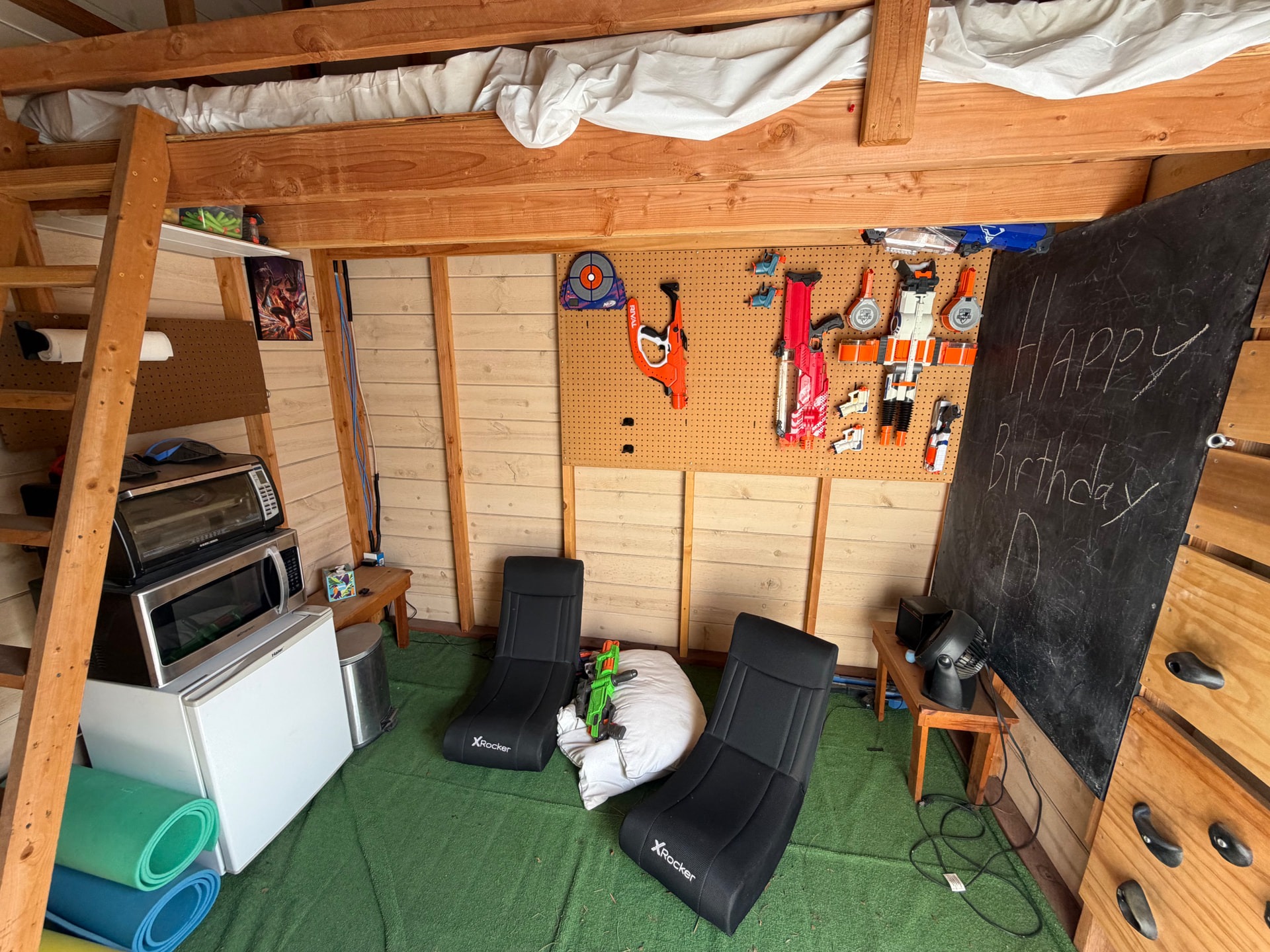
Okay, sounds good. This is the area I am going to put it, which is why it needs to be able to fold up. I’ll clean the place out, set it up either on the floor or on some sawhorses, and I’ll go from there.

1 Like

I have a class during which I can work on designing something like the table, I will work on the CAD during the week.

2 Likes

Would something like these work to start with and break before I buy some good ones?

Those will work and you wont need the 1/8” collet or adapter. Good find.

These have gone up a bit in price but are similar to the last batch i bought for $12

https://a.co/d/00ZNp1jX

Will the ones you just linked need an adapter? Which are better, the ones you linked or mine? It looks like the cutting side of the one I linked is smaller, I’ll go with yours. Only problem is it doesn’t deliver until May 11-21, so I’ll be waiting quite a while

If you bought a makita 700 like you showed us, it only comes with a 1/4" shank. I sell 1/8" shank collets in the v1 shop.

1/8" shank endmills are far less expensive and pretty forgiving for beginners.

1 Like

Thanks, I was wondering if I’d need to use a different filament but that’s a very helpful experience.