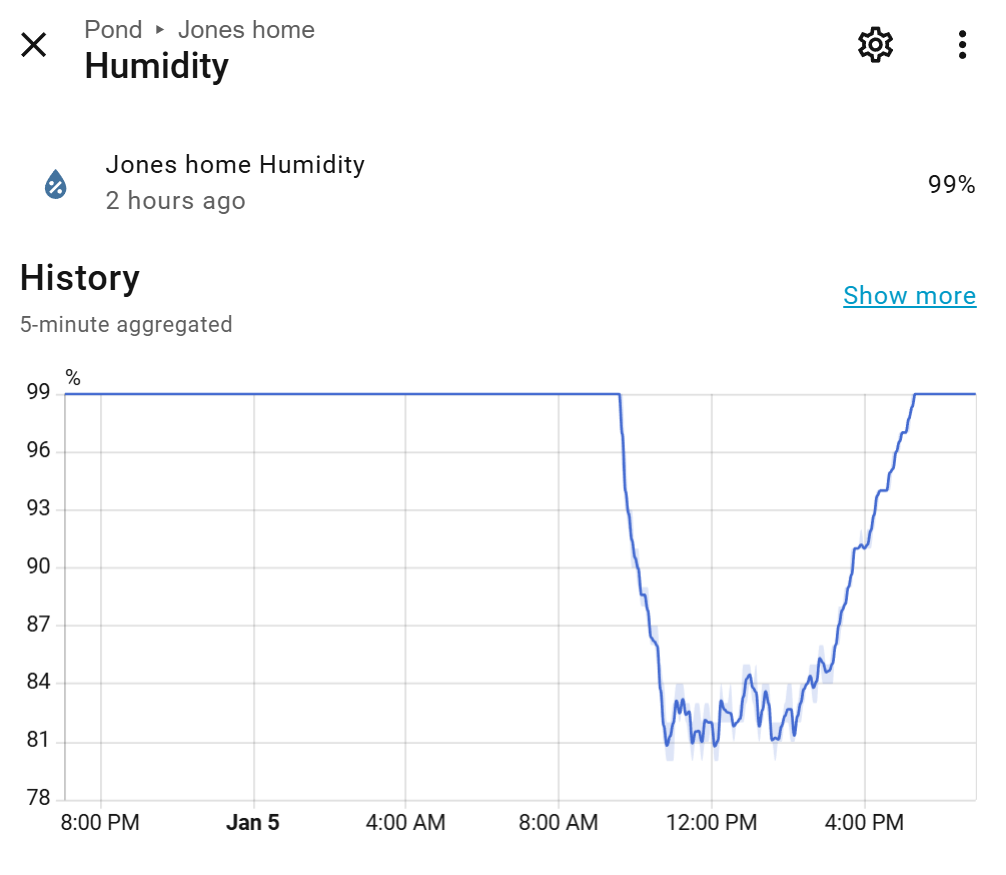
Also depends on how wet your environment is. Where I live its always 75-99% humidity outside and 40-50% inside so I have to keep it dry. If you live in a dry climate you might get away with drying it once and it being good or not drying at all.
What desiccant are you using?
Activated Alumina Desiccant is more easily reusable and lasts longer for more production style use.
I use this stuff…
When it starts turning pink I run it through the dryer and its back blue again.
I use it in the bottom of my totes and in my dry boxes that I print from on some of my printers
Give this stuff a try:
Thank’s Jim! Just ordered some to try it out!
I’m assuming this is not a typo.. 12 hours.. woof.
I guess my next investment will be a dryer - I’ve looked at a few on Amazon, and see some I like the look of. Does anyone here have a recommendation? I’d also like to look at getting some form of sealed storage solution, if humidity is something I need to be concerned with.
@MakerJim thanks for the rec on desiccant - I’m likely going to put an order in as well!
I think I’m going to grab an enclosure for my printer, until I get the LR4 running and can build a proper home for printer and filament both.
I assume (at my own peril) that it would be recommended I bake a spool of filament prior to trying another print of the LR4 parts? And yes, I still have yet to complete the calilantern measurements and calibration. Got sidetracked this evening cooking beef stew  .
.
I do have another spool of unopened Elegoo PLA, which is vacuum sealed with a desiccant pack. If I calibrate via calilantern, would this be safe to use on another attempt on a less naively chosen part?
I don’t know enough about your printer, but you can build a dry box spool holder to pull from.
In some cases, you can get away with pulling a spool out to print while you go. In my case, for example the Colorado front range humidity is usually always low. A super weirdly humid day here would be a super weirdly dry day for JJ.
I worry more about getting the arriving spools dried out if I test them and they appear wet. That’s surprisingly common where I pull a spool out and it’s pre-saturated with water.
I wouldnt worry about an enclosure. That will cause issues printing PLA if it traps too much heat. Once you dry PLA it will take a week or so sitting out before its wet again, if not longer. Dont over think it.
That’s probably on the long side. I usually run mine for a 24 hr cycle but I am always ahead of the game on it.
Yes I would for sure dry your filament before you try and print any more LR4 parts that’s for sure. While you have your filament drying you should measure up your Calilantern. After you make your adjustments I would suggest printing another to verify everything is good afterwards.
As @MakerJim says, most of the time they are super wet brand new out of the pack. When they make the filament they run it through a water bath to cool it down before spooling. This gets it very wet. Some manufactures dry it after spooling, most don’t.
I honestly have no idea what the general humidity is in my region (Upstate NY), but I think it would be best if I 1) found some good storage bins that allow for the spool to feed to the printer, or 2) similar, but in a dryer form such as this. If you have recs, I’d love to hear them.
How might I go about testing? Is there a specific tool? (I enjoy too much getting new ‘toys’..)
TIL. While I cringe at the prospect of putting my cardboard spool in my oven at 122°f overnight, I definitely need a solution… Again, recs appreciated.
I have a bunch of these Humidity Sensors in all of my totes and dry boxes. Also have one out just sitting on the shelf monitoring the room. They are super cheap and seem to work pretty well. The lowest they read is 10% but thats plenty low. Anything under 25% you are good to go usually.
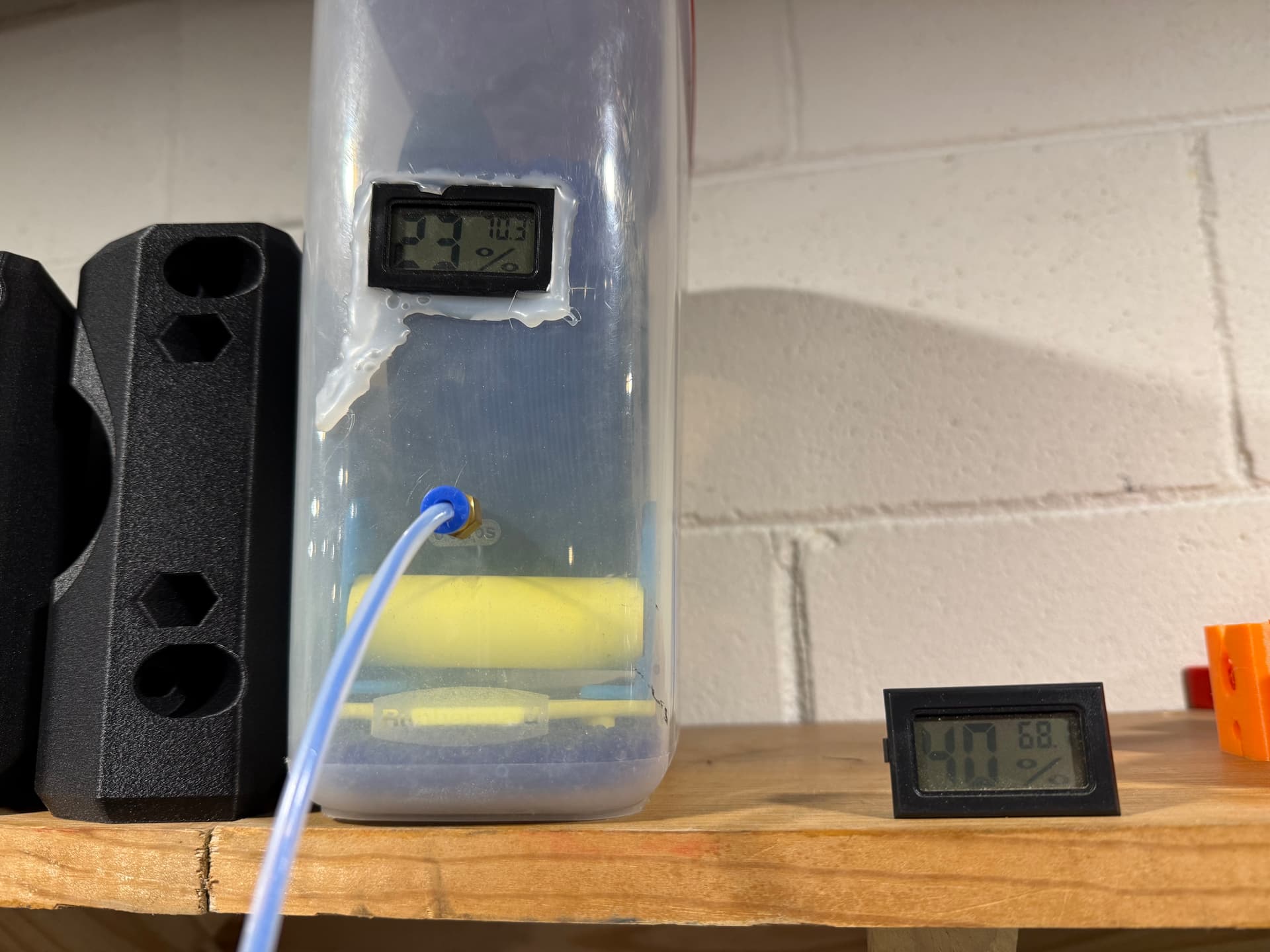
Thank you - these look perfect.
yeah, I may be in a similar boat..
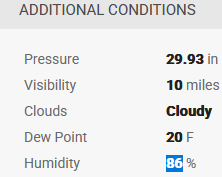
Just saw this, is this really an option?

I have seen that before but never tried it my self. Worth a shot. Probably better than running your oven all night long
Considering it’s a gas range, yeah…
Again, I want to thank everyone here for their help. I almost lost motivation after my first failed print, but knowing how to fix it makes the difference  .
.
I’m still looking at storage and dryer options, so feel free to weigh in. I’ll get back after I finish measuring and calibrating the calilantern. Speaking of, and of recs, is there a community-preferred tool for measuring? I have a cheap digital caliper, which is decent enough for maybe 1/10mm, but doubt it’s terribly accurate past that.
I use these from Amazon
I have no personal experiance but I know @Michael_Melancon has one of these dryers and has said good things about it.
I use these Rubbermaid Containers as a dry box to feed to the printer. I have a 3d printed spool holder in the bottom. I will try to find the file and link it for you
Here it is…
I print the bottom part that’s the desiccant riser and pour desiccant in the bottom of the box before I put it or the spool in.
I use these 20 quart containers with a lid that has a gasket. I can fit 4 spools in there and I just put some dessicant in with them.
They seem to only sell 6 packs online but singles are cheap in the store although I normally avoid that store.