I think the color variation is because of my inconsistent movement of the beans. I will have better data after the next roast. The only way I have to currently measure the temperature is with a dual probe meat thermometer which goes up to 300c. I don’t think the heat gun is kicking in any temporary heat change as the gun itself is cool to the touch. I will put the watt meter on there tomorrow to check that though. If the battery screwdriver works ok, I will be able to tell whether the consistent movement works better. I charged it up last night, so batteries should be good. The roasted coffee smells good.
1 Like
If the heat gun is temperature controlled then you’ll have output power varying with airflow rate, so more beans in will block more airflow meaning slower temperature rise, but also more beans means more total energy to heat up, meaning even slower temperature rise.
With the watt-meter on there and measuring the output temperature you should be able to see this by blocking the vents a bit. If the power stays constant and the temperature increases as you block the inlet vent then it’s uncontrolled. If the power drops and the temperature stays constant as you block the inlet vent then it’s temperature controlled.
If it is temperature controlled then that’s not the end of the world, but you’ll just need to be wary of choking the airflow with a batch of beans that’s too big, as it’ll have a compounding effect on temperature rise.
1 Like
I hit 2nd crack, but beans still vary in color some. That seems to be that they are not getting mixed well. I used the battery screwdriver which ran at 17.5rpm. I lost maybe 6 beans or so. Think I will try another roast & turn down the heat some. This batch took less than 8.5 minutes. Some of those beans might have gotten a little burnt, but the roast smells good. I did a video of it and will post that later. Now I am going to try another batch with a little lower heat, the 6:1 gears and the 10” extended screen on top.
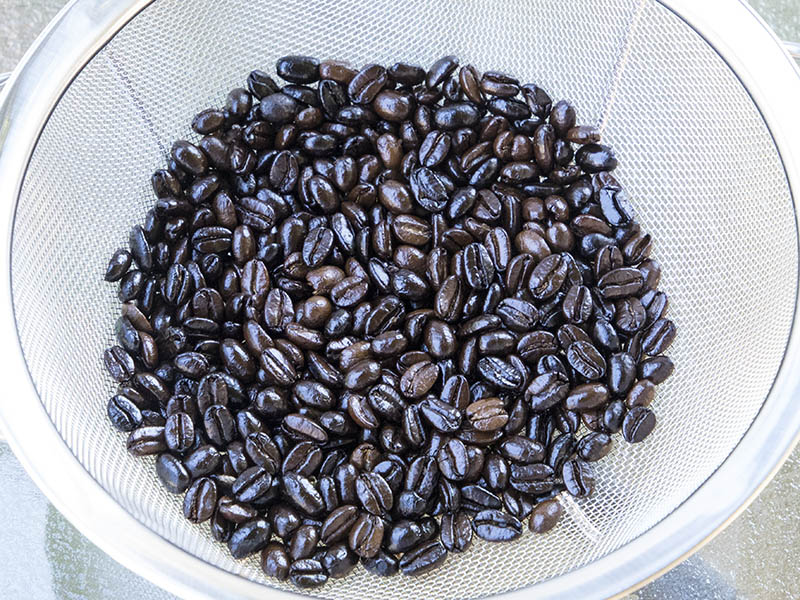
Interesting result. That timing seems like it’s too far on the high power side which I suspect would also increase variability. Those look a lot less variable than the last batch, although that much oil immediately after roasting means you’ve likely gone way, way past 2nd crack. That’s not surprising given the beans were likely increasing in temperature extremely quickly at that point.
I can’t remember what the general ‘ideal’ time is, I just remember that the popcorn poppers at 5-6 minutes were considered way too fast to let some of the caramelisation reactions occur properly leading to a lack of flavour development and the Behmor at 25 minutes was considered way too slow so it would result in esters breaking down and losing flavour.
I also vaguely remember that the generally preferred approach was to get the beans up to temperature very quickly and then slowly progress from 1st crack onwards. I think the goal of that was to minimize the time spent at elevated temperatures, in general, while drawing out the time spent in that 1st-2nd crack phase.
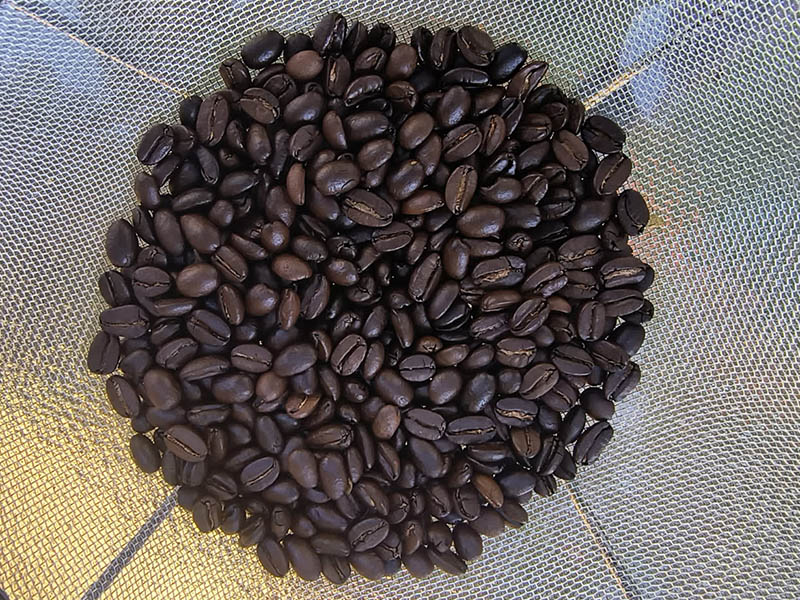
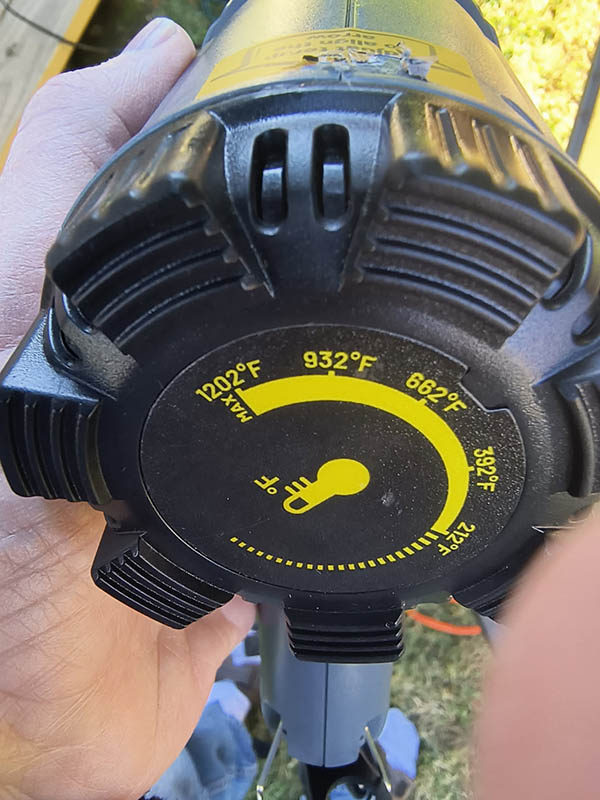
2nd roast of the day I change gears from the 9.5:1 to the 6:1 and turned the temperature on heat gun down from the max 1202f to about 932f and it took about 13 minutes. Not quite as shiny as the 1st batch but thought I might have gone too far with the 1st. It did smoke some near the end. Seems like I need a better way to mix the beans like I have seen in some the videos with this style roaster. Here is a photo of the 2nd roast of the day along with heat setting I used on the heat gun.
Is the power changing when you change the temperature setting?
I would think it would be, but I did not check that on the 2nd roast. I will just plug it into the watt meter tomorrow and see how it changes with adjusting that.
Here is the video I shot of that 1st roast today.
Yeah, it may be that the bars aren’t enough, they may either need something like wires between them to get a bit more ‘drag’ through the mass or more speed so it’s pushing stuff around with a bit more momentum. It should be quite a significant randomisation effect, not just a movement/stirring.
That definitely looked to me like you went crazy deep into 2nd crack. Great as a proof of concept but I presume that’s not the goal?
I could get some stainless-steel wire to wrap around the agitator. What do you think about these wrapped around 2 of the agitators. I’m not sure how well they would bend, but the stainless-steeel mesh I have bends well. https://www.amazon.com/Mozeat-Lens-Replacement-Stainless-Slicing/dp/B0CJR24B7S
No idea, sorry. I think it’d come down to how you’re going to secure it to the agitator. I was thinking it could be cross-drilled and threaded through, but that’s going to be a real pain with small drills and round stock in stainless and also likely to need the rotating part removed to do it…
Having any fixing method need to be food safe and resilient to high temperatures really makes things challenging…
I found some 22 gauge Solid Bare 316 Stainless Steel Wire dead soft that should be safe to use. being dead soft, it should be easy to bend. I think I can knot it off at the end of the center M5 rod. Not sure how well it will wrap and stay in place around the outer wire cage. I have a lot of small copper wire I could test with before trying the stainless steel to see if it is doable. I know I can’t use copper wire in this environment but would be inexpensive to test. Drilling those would be quite difficult I would think, especially drilling them in place.
Why can’t you use copper wire, out of interest?
I didn’t realize copper would be harmful until my neighbor yesterday mentioned it. Do a Google search on “is copper wire food safe”
People cook in copper all the time without issue and I doubt a bit of wire as a test case would be an issue. Especially considering that the beans will have incidental contact it and then have hot water pulled through the grinds… But either way, really.
Those are different types of environments it seems. Here is some more detailed information on that. I know you do not like ChatGPT, but in this case it seems to be good information.
When heated in air to roasting temperatures (200–250 °C or higher), copper oxidizes rapidly, forming cupric oxide (CuO) and cuprous oxide (Cu₂O). These black oxides can flake off into the beans, and if heated hotter (especially near a heat-gun jet), copper can release metal fumes that are toxic if inhaled in quantity. It’s the same hazard that makes “copper fume fever” a concern in welding or smelting work.
What happens during roasting
-
Your beans will easily reach 220–240 °C (crack stages).
-
The heat gun’s output stream is even hotter—often 350–500 °C right below the mesh.
-
At those temps copper forms oxides and may discolor or flake. Those oxides are not food-safe.
-
Any vibration or brushing against beans or the sifter will shed tiny black particles that could contaminate your roast.
Why copper can be food-safe in cooking & brewing
Copper itself isn’t inherently “poisonous” — it’s actually an essential trace mineral — but too much copper exposure (especially soluble copper compounds) is toxic.
So safe use depends on preventing copper from dissolving or oxidizing into food or vapor.
In copper cookware and kettles:
-
Contact medium: Water, wort, or food — not air — and temperatures are much lower (typically 100–120 °C, not 250–500 °C).
-
Protective layer: Over time, copper forms a thin, stable oxide layer (patina) — primarily cuprous oxide (Cu₂O) — which actually protects the surface from further corrosion in moderate, wet conditions.
-
Tin or stainless lining:
-
Many copper pots are tinned inside (a thin tin coating) so food doesn’t contact bare copper.
-
Modern brewery kettles are often stainless steel-lined copper or entirely stainless.
-
-
Non-acidic environment:
-
Brewing wort is mildly acidic but not hot enough to aggressively leach copper.
-
The exposure time is limited, and the liquid dilutes any trace ions well below harmful levels.
-
So in controlled, moist, moderate-temperature situations, copper is stable and even desirable for its thermal conductivity.
Your choice. I wouldn’t worry and I’m not going to engage with that AI summary at all, sorry 
Claude somewhat agrees with ChatGPT, but is less “Doom and Gloom”
Yes, copper is generally acceptable to use in coffee bean roasters, but there are some important considerations:
Advantages:
Excellent heat conductivity, which helps with even roasting
Historically used in traditional coffee roasting equipment
Durable and long-lasting
Important considerations:
Food-grade copper - Make sure any copper components that contact the beans are food-safe and free from harmful coatings or contaminants
Temperature concerns - Coffee roasting reaches temperatures of 400-500°F (200-260°C). Copper can handle these temperatures, but be aware that copper can oxidize and develop a patina over time
Acidity - Coffee beans contain oils and acids. While copper is relatively resistant, prolonged exposure to acidic compounds can cause some reaction. This is typically minimal during the brief roasting process
Cleaning and maintenance - Keep copper surfaces clean to prevent buildup and oxidation that could affect flavor
Common usage - Copper is more commonly used in the heating elements or heat transfer components rather than as the primary drum material (where stainless steel is more typical)
Many professional and home roasters successfully use copper components. Just ensure proper food-safe materials and regular maintenance. Stainless steel is often preferred for drums and surfaces that directly contact beans due to its non-reactive properties and easier maintenance.
What part of your roaster are you planning to use copper for?
Retry
D
What about concerns about cupric oxide or cuprous oxide
Great question - this is an important consideration! Both copper oxides can form during roasting, and there are legitimate concerns:
Cupric oxide (CuO) and Cuprous oxide (Cu₂O):
Both form when copper is heated in the presence of oxygen, which is exactly what happens during coffee roasting. Here are the key concerns:
Health considerations:
These oxides can leach into food, especially in acidic environments (coffee oils are slightly acidic)
While copper is an essential trace mineral, excessive copper intake can be harmful
The FDA has limits on copper migration into food (typically around 0.1 mg per serving)
Chronic excess copper exposure can cause gastrointestinal issues and, in extreme cases, liver damage
Temperature factors:
Cuprous oxide (Cu₂O) forms at lower temperatures
Cupric oxide (CuO) forms at higher temperatures (above ~300°C/572°F)
Coffee roasting temperatures (200-260°C/390-500°F) are right in the range where oxidation occurs
Why stainless steel is preferred: This is actually one of the main reasons why stainless steel has become the standard for surfaces that directly contact coffee beans in modern roasters. It doesn’t form problematic oxides and is non-reactive.
If you still want to use copper:
Use it only for heat transfer components that don’t directly contact beans
Consider tin-lined copper (traditional for cookware)
Keep surfaces well-maintained and polished
Monitor for excessive oxidation
For direct bean contact, stainless steel is really the safer choice.
I’d probably use stainless long term, but for testing/practice I’d use whatever I had on hand (copper).
AI = 

1 Like
Put a good thermocouple or thermistor (or a properly calibrated IR pyrometer with the correct target emissivity set) on the surface of a good copper or stainless pan. Drop in some cooking oil, light the burner. Let it heat up to cooking temperature.Take a measurement.
Then come back and tell us if AI got anything right about cooking temps or if it’s pure slop.
If its pure slop, extrapolate that to the overall results.
Edit- not that I advocate to use other than food grade stainless steel agitator parts long term.
That should be the case for a bunch of other good reasons.
1 Like