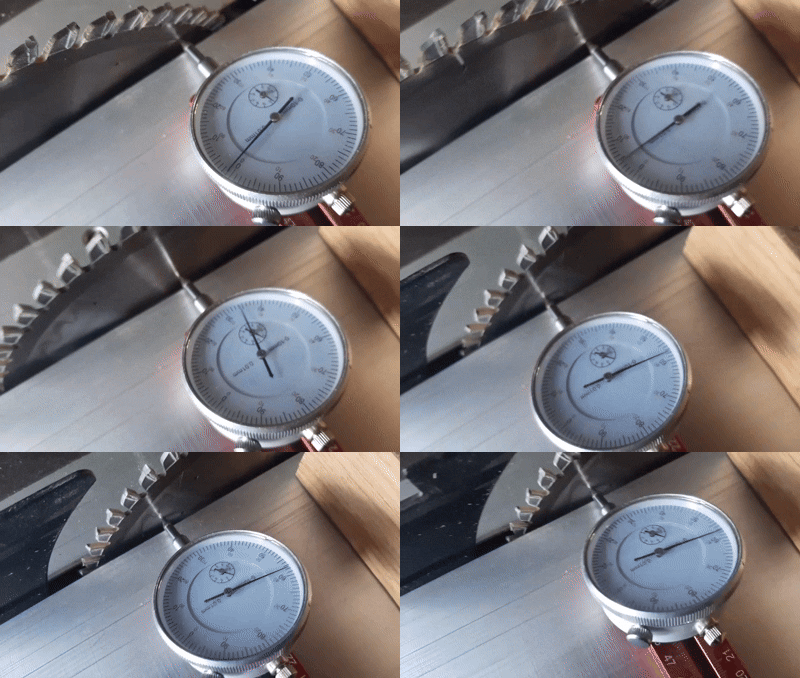
I tried so many times to align table saw I bought some time ago. But whatever I do it’s always throwing chips into my face (meaning cuts up with the back of the blade).
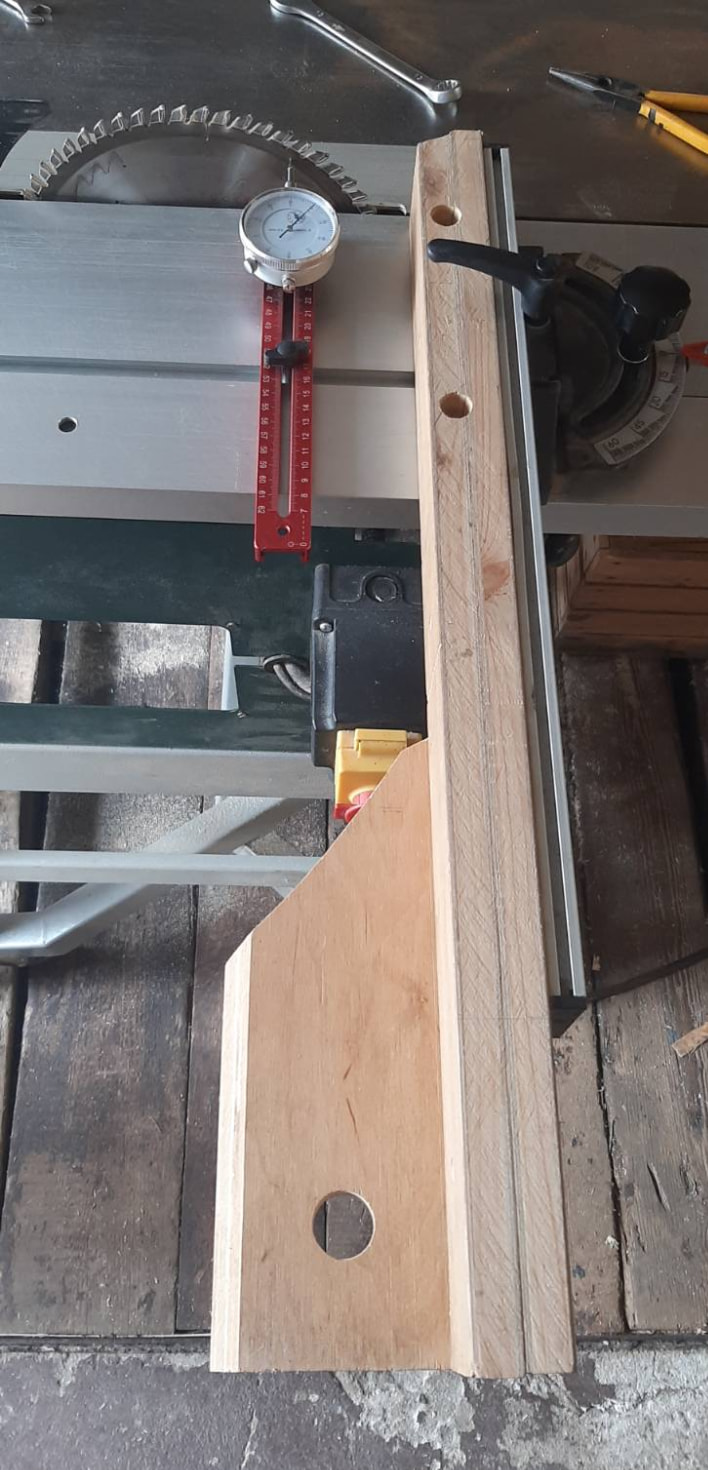
It has no miter slot on the right, so I’m putting gauge between fence and blade and try to adjust screws on the fence bar so it will be parallel.
Can you take a look and tell me how you would approach adjusting this saw?
3D print or CNC machine a jig to fit in the mitre slot on the left that goes to someplace that you can anchor the fence. If the mitre slot is larallel to the blade, then placing this at the front and back of the table will give you the best chance of adjusting the fence to be parallel to the slot, and therefore the blade.
If the slot is not parellel to the blade, then I’d be looking under the table at the saw motor mount, and seeing if there is a way to adjust that, or else see if there’s a way to adjust how the 2 halves of the table fit together in order to adjust that.
Mitre slot is on the sliding table and that has number of adjustments possible. Saying that, I have found guy on yt who said he owned this saw model for 10 years and didn’t manage to get that sliding table parallel to the blade
However, now you said it, it seems like correct thing to do. Challenge accepted.
This is british saw, no wonder they have put mitre slot on the wrong side And guess what - even it’s sizing is funny, so I can’t buy insert off the shelve!
It’s also interesting to where the blade tilts. European saws always tilt to the right, American ones to the left (which I find more useful with a sled)… But here we are.
What exactly are you trying to align? The sled, the parallel fence?
Fence. I want to be able to cut elements which will have parallel sides. Also fact its chipping material with back of the blade makes it very bad quality cuts…
This is interesting, Since both are usually a adjustable to some degree, this is a chicken on the egg situation. Which one do you adjust first, what is THE reference.
That I absolutely do not understand? How can it touch the wood with the back?
The fence should never be completely parallel, it should open up around half a mm or so so stock does not get stuck. If you want a great helper and have a sled (which you do), build a Fritz und Franz. It’s a gamechanger.
You need to check what you can adjust on the saw to figure out in which order you do adjustments.
The slide needs to move as parallel to the blade as you can get it.
The same goes for the fence. As stated by @Tokoloshe already, have both of them opening up slightly instead of closing in on the blade.
If you are certain you can measure more accurately than 0.5mm, then go closer that that.
The miter slot doesn’t need to be parallel to the blade, as you don’t need to slide something through it thanks to the sliding table, but it’s nice if it’s also parallel.
Edit: For use with Fritz and Franz, you’ll need to retract the parallel fence so it ends in front of the blade. That means you can’t shim it with that washer anymore
Also, as you can see on the photo above - I managed to make measuring jig out of a tool I have for router. Disassembled it and one part is working perfectly as a measuring tool
It’s baffling to me that it seems really unknown outside of Germany.. It’s a gamechanger, you can saw the tiniest pieces you could not with a pushstick or fence.
Being painfully monolingual and viewing it on a phone, it looks like a fence that secures the workpiece both fore and aft, turning the whole thing into an ad hoc sled-like contraption that is easier to manipulate from outside of the path of the blade, and any potential kickback of the offcut.
Looks very safe, and secure, and less prone to operator error mangling stock, but it feels painful for repetitive cuts, at least compared to a sled and stop blocks. Maybe quick clamps would mitigate that.
But then, my table saw has more dust on it from storage than it ever has from usage…
No, because you have the parallel fence with the correct distance but drawn back (so it can’t jam between blade and fence) you and can just push your workpieces against it.
You can see it here, first picture:
Golden rule is: only one guide/restriction if you don’t want to mangle yourself.
This is spam really, because you can make a very accurate alignment gauge using two bits of stick with a screw in the end against the blade, but make the track/ table parallel before you do anything else- then worry about the fence.
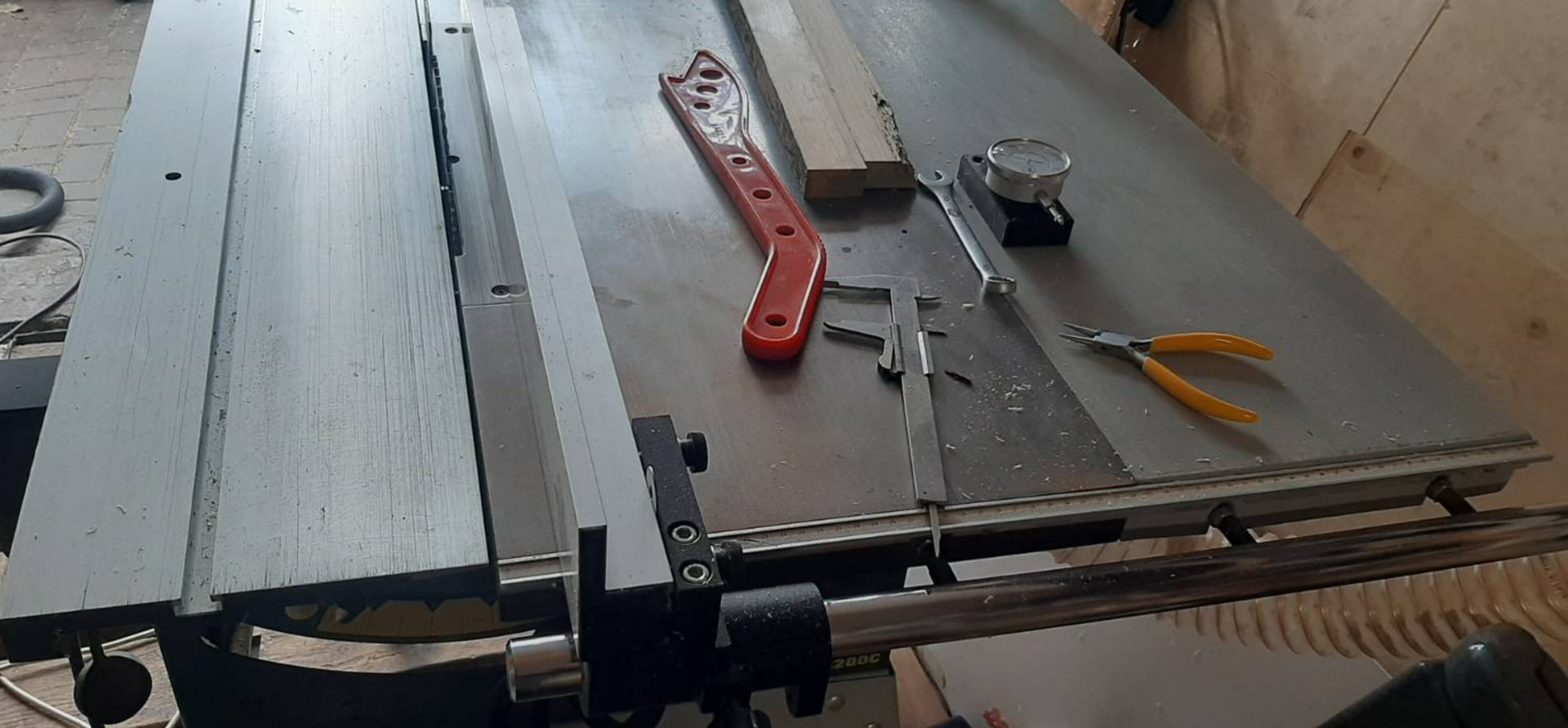

 And guess what - even it’s sizing is funny, so I can’t buy insert off the shelve!