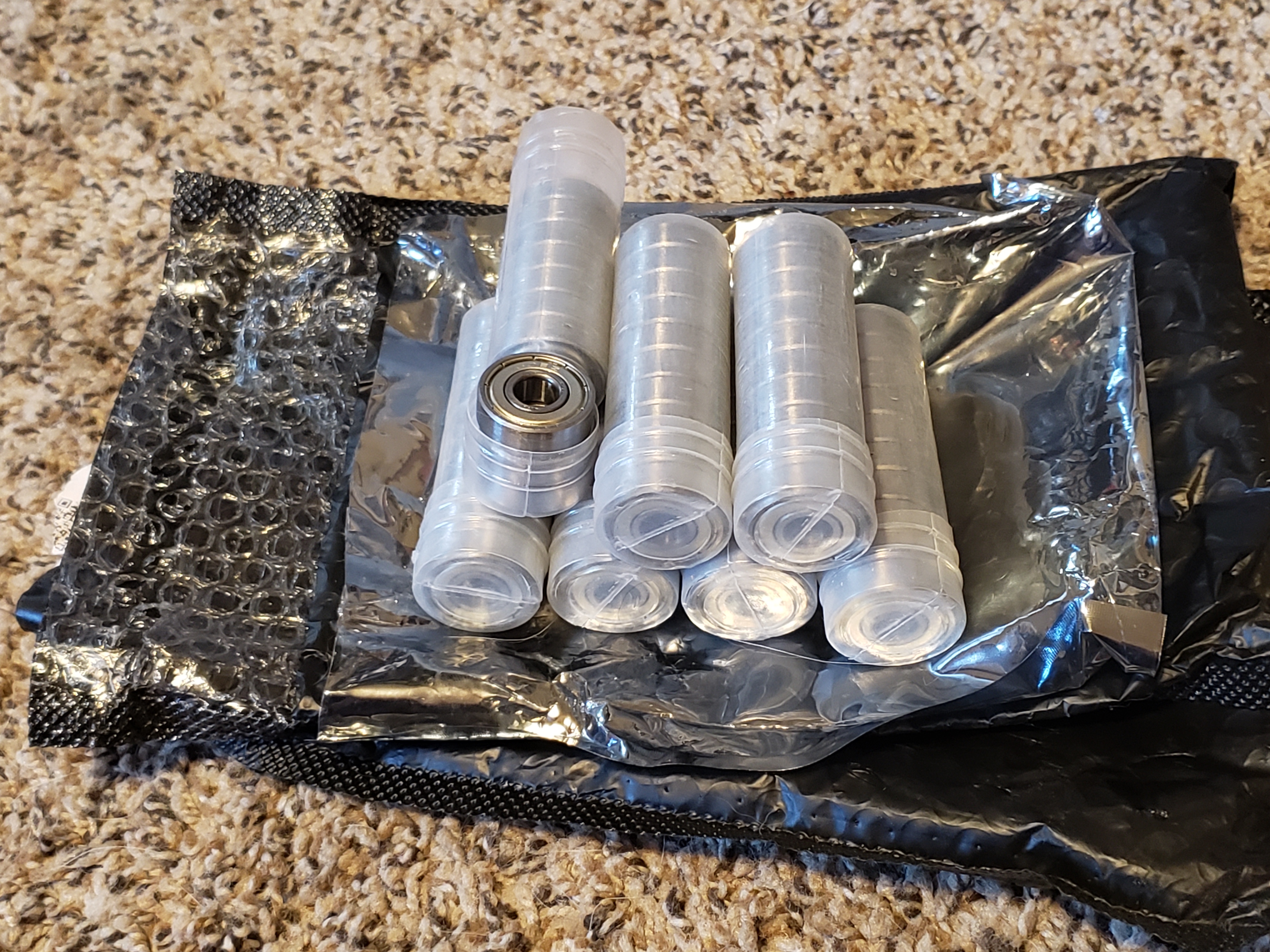
I always have boxes and they usually only take three days to get here, been 2.5 weeks. But they keep passing me and not getting delivered. left frisco (45min west of me) hit Sac (45 min north of me), hit a few cities in between.
I have a question. If I stack the corner clamp over the base the tube length needed for the legs is about 55cm. Does this leg length result in the minimum Z range? According to the calculator that would be 76cm Z range. I would prefer to go even shallower if possible, like 5cm.
Also, is there a practical reason to avoid such a shallow machine? Any pitfalls I am not aware of as a first timer? Like difficulty changing bits, etc?
I plan to build a long, narrow and shallow Primo (135x45x? cm) with mid span supports for the longer axis. I’m about to finish printing the parts, just missing the core! Wish me luck!
In this current situation nothing is surprising at all!!! I signed up for alert and will be ready to order!!! Great project, really excited to get into this, first CNC with no experience so Ill be working though tutorials on software/design/methods as well until I am built.
Make sure to give yourself at least two extra mm, and make sure you are measuring to the bottom of the leg lock not the top of the Nut holder. The calc should be dead on.
Something isn’t adding up in my calculations, I may be doing something wrong. The calculator specifies 60mm legs to achieve the default 81mm Z range. Yet, if I stack the leg lock above the corner clamp I get a 61mm of minimum physically possible leg length (I tested this both in real life and in CAD). If I add the recommended extra 2mm I get even farther from the calculator’s 60mm. I am assuming the tube has to touch both the table and the bottom of the leg lock which seems to be the case. What am I doing wrong? Thanks!
In CAD, the dimension is 61mm ( I actually just checked again). Your prints could be 1mm off. Your legs could be 10mm off and the machine will still function perfectly. +2mm is my personal preference. As you can see though my calculator has to be exact as people will check it.
They look a lot better than the last batch of 100 Chinese 608z bearings I bought from eBay. I had to bake this horrible fishy grease off of the that batch in a cosmoline oven, and even then I had a high junk rate, around one in six.
This batch of bearings looks very consistently packaged and rust-free. From a semi-random sample of four, they appear to consistently spin very smoothly, even with an axial load.The ones I tested are so full of grease that they don’t free spin.
Any recommendations for testing them, or should I be good to go after wiping the excess grease off of them? I’m wary after that bad batch.
Fair enough. I will stick with the Primo, I am confindent I can make it work for my needs. Also, I think its good to have people push your design to it’s limits and then share the successes/failures. I can always make it smaller at the end of the day.