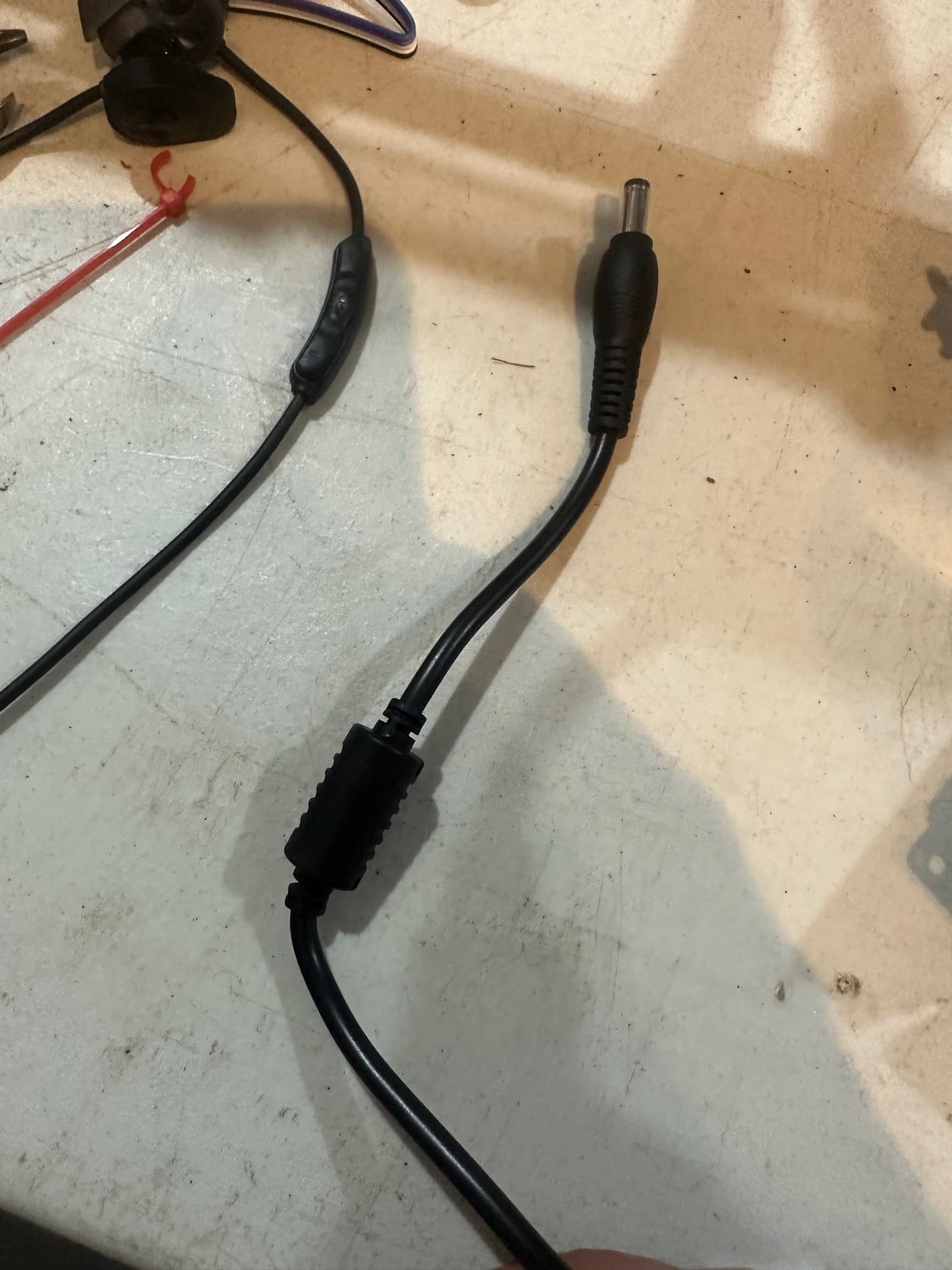
Just when you think it is safe… another rookie question. The instructions show to connect the power supply to the board polarity matters. My cord has a socket plug on the end. Am I supposed to cut that off or am I missing a wire? If I am supposed to cut it do I cut above or below the plastic barrel on the cord?
@vicious1
Well that is one option, but the other option is to purchase a mating connector with a pigtail, and then connect that pigtail to the board. That way you could have an easy way to disconnect the power supply from the board if needed (cons include the possibility of the connector coming apart during a cut).
The power supply I got from Ryan (24V) came with the wires bare and tinned (no connector)
Make sure you test for polarity before connecting anything!
That is a noise suppressor (coil). Ideally keep it in, but the wire may be too short to reach if you do, so cutting it out may be necessary (and not super critical)
1 Like
Thanks, I purchased my kit from Ryan all be it about a year ago and it is a 12v at least that is what it shows on the box. Any suggestions on where to get the pigtail or specifically what I need to search for? I am not real excited about cutting the cord.
I buy mine in bulk due to some of the stuff I make at the day job. But here’s the kit I get
I say bulk as it’s 10 pairs but it’s enough for me I don’t have to order too frequently and don’t have to find big storage space
2 Likes
The nice connectors that Andrew ( @Peacester ) linked for you would mean you don’t have to cut that cord! It’s what I used.
1 Like
Thanks Doug, I am going to make a trip by micro center tomorrow in hopes that they carry them before I order online. Just trying to move forward as quickly as I can and I am at the point to install it. Following the instructions in order so I don’t goof anything up. I hope!
2 Likes
They do. Well at least mine does in the electrical section. It unfortunately one of the not listed on website things. If you show them that photo one of them will know where it is or if your location has it
I just cut them. The connectors can be a source of issues if you are not careful.
2 Likes
Ryan, if you dont mind and it can be brief but what would the issues be? I have found and purchased a connector but now you have me unsure which route to take. Do you cut the “noise suppressor” out or leave it? There seems to be conflicting answers on cutting vs using the adapter coming in, one says yes one says no, but since you are the one who designed and masterminded this rig I would like to have your input PLEASE! Unfortunately I have no experience with this, none whatsoever.
For future reference found this at micro center in Marietta GA, in the CCTV section.
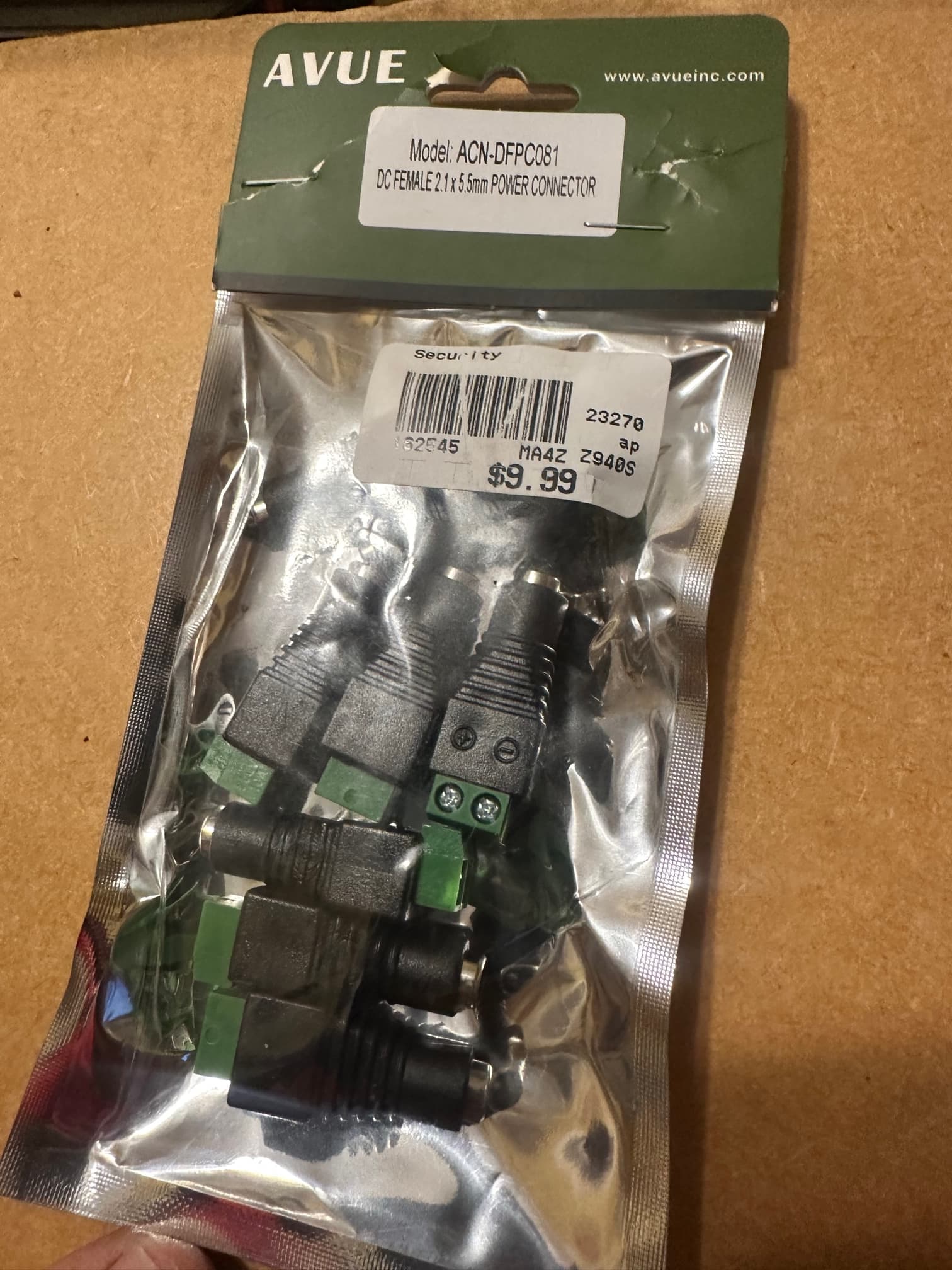
I’m sure Ryan will respond. But here’s my two cents. If cutting cut minimal amount if cord (leave the coil alone/noise suppressor). The errors he’s talking about is leaving exposed cables and/or over/under tightening. There’s others too. Something I never considered as I’ve done a lot of electrical before
1 Like
One possible issue is you start with a tight connection but over time it gets loose. But if that happens, they’re not hard to replace, and not out much on the price.
1 Like
We had those same connectors that came with the power supplies. Most people were fine. But sometimes they would not have a good connection. Cutting the cord and hard writing it makes a more reliable connection.
4 Likes
Got it, so basically the normal problems that happen when making most all connections. I guess to some these are overlooked. I do have a long background in 12v work and electrical along with golf carts which helps me some with wiring and such. Also not mentioned because I assume everyone is the same, but normally when I cut/splice/jump wires into screw locks I either use pin connectors or will tin the wire before I put it into a screw type connector (not proper product identification) like on the adapter I purchased. So bottom line thank yall very much for the support, input, and info.
Something I ran across last night and would like to know, is there and advantage with 12v vs 24v and would I have to change the board that I have now? When I purchased my kit I don’t remember an option of 12 or 24 and now I see in the store is a 24v power supply. Figure while I am this point might as well get it right now.
The board is capable “as is” for either 12v or 24v.
The 12v is great for this application. The only advantage of 24v is faster “rapids” speeds. The cutting action does not need that added speed advantage. 24v is also great. Bottom line, either works, and if you already have a power supply, I’d use it regardless which it is.
3 Likes
Doug, Awesome explanation thank you!!
2 Likes
This probably requires a bit of electrical theory. I’ll keep it in layman’s terms as much as possible…
Whenever you convert AC to DC, there is inevitably a little bit of “noise” superimposed on the final DC voltage (also known as AC ripple). A noise filter in the form of an inductor (coil or toroid) is often attached, as inductors pass DC current, but restrict AC current. The amount of “AC resistance” (actually known as impedance) is dependent on the Inductance of the coil and frequency of the AC signal.
Cheap 12V AC-DC converters usually have some measurable amount of ripple, and this may be made worse by electrical noise in the environment (like an AC motor from a fan or router running right beside the 12V power cord). So it is usually desirable to retain any noise suppression devices (or even add your own).
But the boards can usually withstand a certain amount of ripple/noise before any adverse effects become apparent, so it is certainly possible to run without any filter. You do run some risk without using a filter (more with data corruption than with damaging the board), but I suspect that the majority of users here don’t have a filter on their power supply cable (I don’t), and probably never have any noticeable issues.
So it is really a choice that you can make, whether to keep the filter or not. Personally I would try to keep it in line, but as mentioned, that may make the cable end too short to reach the board. You could always solder on a short piece of cable to extend the cord if you do cut off the connector.
Or as mentioned above, you could add a mating connector, which could add some convenience for disassembly, but keep in mind that there have been some negative results (most likely one would be having the connector come loose due to vibration or tension on the cable during operation). You could mitigate that by securing the cable (strain relief) so that it can’t come loose until you want it to.
2 Likes
WHOA that took me back to Ham radio courses.
2 Likes
If you can build/operate a Ham Radio, wiring up the LR3 should be a breeze!
4 Likes
No worse than the hysteresis primer we got when we re-wired the department for 100Mb ethernet (why we keep the pairs twisted, why we don’t cross fluorescent bulbs, and try not to cross, well any other cables at 90 degrees if possible, just in case they carry a significant load).
2 Likes
99% chance it is actually fake.
5 Likes