Yes I guess it’s possible to implement that. I’m guessing some more advanced triangulation/trilateration and some other math.
You will need a bed sensor (like a probe).
You will always need some sort of reference values though (I believe) and/or a set of constrains (like arms with same length or tower forming an equilateral triangle) or else the math will be just nuts.
While I’m trying to solve the simulator problem I’ll try to think about that subject also.
EDIT: I think I’ve fixed the geogebra simulator. I barely know how to operate the geogebra app but I’ve manage to fix the error. Here is the link. I’ll recheck my previous results now.
EDIT2: This will be a bit long but I’ll try to keep it short.
The results seem to be correct. You can test it your self.
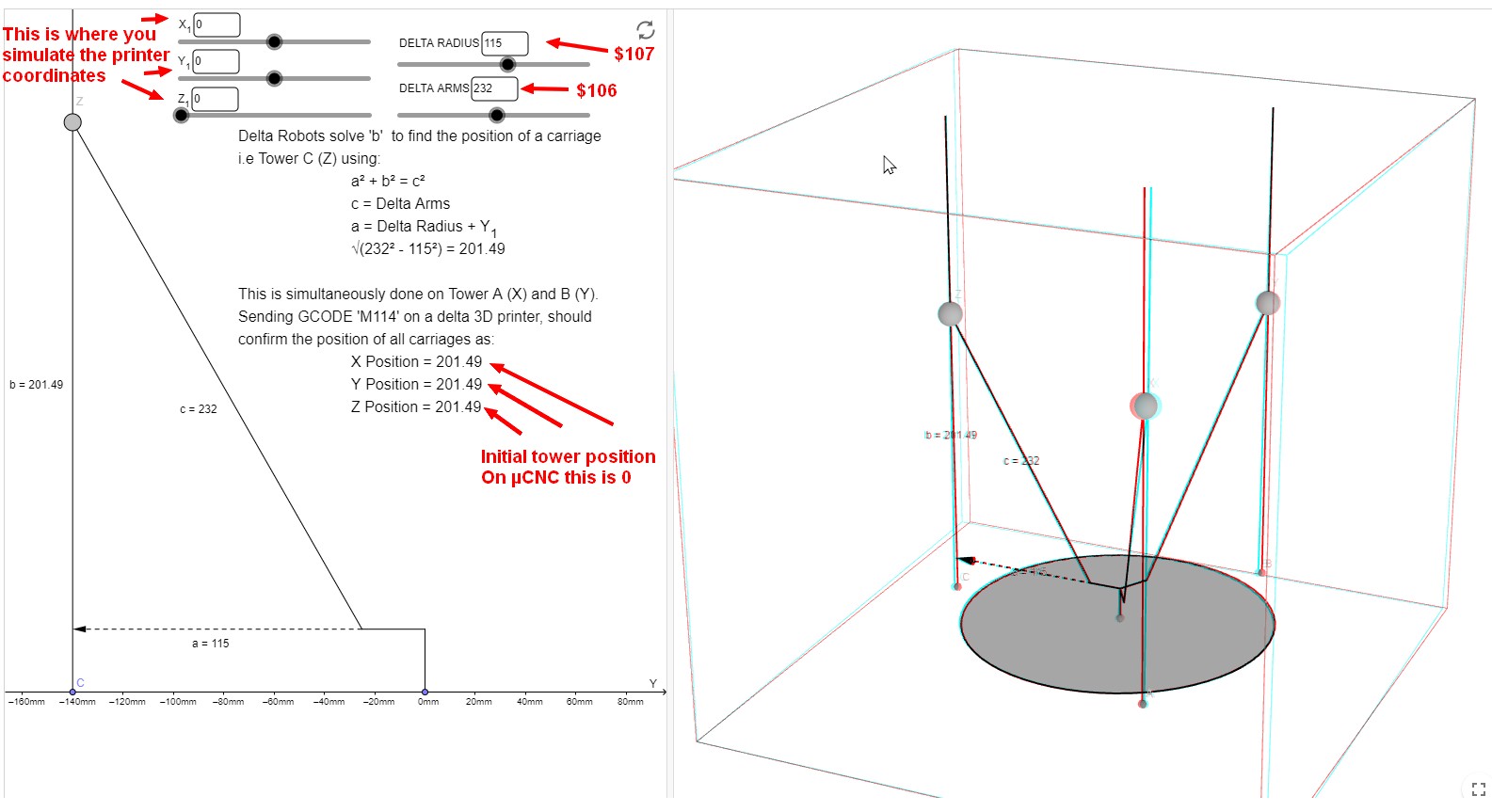
Just to make sure the towers are moving the expected distance please run this test.
- Insert the same values for $106 and $107 on the simulator and on your printer.
- On the simulator take note of the towers initial position (they match for all 3 towers) - lets call this Hini.
- On your printer do a home motion then send the efector down to gain some headroom. Mark the position of all 3 motors (they should all be at the same height).
- Do a G0X40 on the printer. Now measure the traveled distance by each motor (positive if above starting point and negative if below).
- Do the same in the simulator. Again calculate the traveled distance for each axis by subtracting Hini from the current position that was calculated by the sim.
See If they match. This will at least tell you if any step skipping is happening. If not my guess is that parameters $106 and $107 are incorrect.