Out of curiosity what will the thickness of any “plates” be. If it works i would vote for 3mm or 6 mm. I have a bunch of ACM that i can use!
1 Like
I just bought new fancy fans, dual ball bearing, as those tend to go out the most frequently for me.
Occasionally I have filament retract wrong and get stuck (I actually think one of mine has a bad internal PTFE), then fans, then heater / therm. That is the order of things I have to do on the farm. For me a fan on the back is a no go. I have considered putting it on the bottom with very little ducting. I still might. I am willing to sacrifice 5-10mm or so of Z instead of putting two fans on. Of course this would not be standard.
We definitely have to keep this in mind. Of all the extruders out there, most have a “package” these days. If someone is using an orbiter/mosquito/megatron, there are lots of touch probe and fans mounts already made. Those of us that can use CAD proficiently will always be able to make custom stuff. So is the standard these days a flat plate, if so where are the holes your extruder needs wants located?
I am more concerned about when things go wrong. Under normal use, I don’t think someone would ever drive into the belts. With that said, I think it will suit your purposes if you wanted to do that by adding 25mm to the Y depth.
So…I have to double-check all of them again. Currently, I do believe a 5mm set of plates all the way around will work for every piece. That puts us a t M5x35 and M3x10 (with some M3x8 needed for the rails). I think I checked 3mm plate and it seemed a smidgen too big to drop everything down 5mm.
We have a 20mm extrusion sandwiched by two plates. So 2x5mm+20mm=30mm thick and a M5 nut needs 4mm of room…cutting it close (the US equivalent is 0.187" or 4.75mm) so a bit more room even. 2x3+20=26, no room for a nut…but might be the better option for an M5x35.
Then you need to think about the connection to the extrusion itself. We have a 6mm t-nut channel so a 5mm plate means we have 1mm to spare with an M3x10. If we do a 3mm plate we have 1mm to spare with a M3x8.
This was going to be a question for all of you later but now is fine. 3mm (3.175 -1/8" would also work) plate vs 5mm plate (0.187")??
If we do 3mm plate that means we would need M3x8 and M5’s. If we do 5mm plate M3x8 and M3x10 and M5’s. My argument for adding two M3 sizes is the printed part to linear bearing connection seems a lot stronger with that extra 2mm thickness (XY trucks), there are 4 screws though so really probably not an issue.
And remember the plate do not have to be cut material, they can be printed.
You can always recess bolt head hole locations if you want to use a shorter bolt on a thicker material. I’ve found plunging straight down with a 1/4" end mill to work just about perfect for M3 bolt heads.
I’m also using 6mm aluminum plate for most of my parts because it makes it easy to drill/tap holes on the edge of the material. M3 bolts in 6mm material leaves 1/2 of the material on each side of the hole. 5mm material would probably work OK too, just has less meat on each side of the hole.
Extra ops are not cheap. Laser cutting out a whole set of plates would be less than the price of cutting recesses.
Using the edge is the last thing on the list, second to tapping holes!
If someone want to mill up parts it is much more approachable for a home gamer with a new CNC to just do a 2D job, adding that 3D dimension is outside of beginner territory. I am not against it, but currently everything is pretty easily milled or printed.
1 Like
Yeah, just wondering about the ability to easily swap out printer parts for cut parts.
The Voron 2.4 has some options to do cut aluminum plates with spacers that looks really cool.
I am a huge fan of this ACM material from its weight to its stiffness.
2 Likes
I agree on both accounts. I’m just throwing ideas/opinions out there. Eventually I might say something you haven’t thought of 
BTW, regarding the cooling fan. I like the idea of having it slung under the rail if there’s enough Z height for that.
1 Like
Have been assuming 3mm (~1/8") and 6mm (~1/4") plates, guessing they’re commonly available thicknesses in various materials, so not as expensive. Pesky limited size option bolts. Washers? And/or for fastening to extrusion require make to drill recess in extrusion during assembly for bolts that are oversized by 1-2mm? Vaguely recall doing this for my build, probably when securing Gas struts to the extrusion.
Just remember I am not perfect, I will argue my side pretty hard. If you think I am missing something, it is always best to say something like “I think we are talking about different things”.
I love hearing new options if you think they are better.
Plate stuff is available in a ton of thicknesses in the small side. It gets a little different with thick stuff.
That is why I plan so hard for standard hardware. Washer are best avoided if possible since the thickness of them varies a lot. I am avoiding drilling, manual ops as much as possible. If we come up with something super awesome that needs 2-3-4 sided milling it HAS to be printable as well.
1 Like
Available and good bang-for-buck pricing? On https://www.amazon.com/gp/bestsellers/industrial/11260298011/ref=pd_zg_hrsr_industrial, I see lots of options (i.e competition and good pricing, and incentive for flatness quality) for 3mm (~1/8") and 6mm (~1/4"). Not seeing as many options for 5mm thickness.
That said, I don’t care about thickness if you’re planning to sell kits, and/or partner with somewhere that’ll cut and send Alu parts for bang-for-buck pricing?
Any place I have been it is sold by the pound.
5mm and 0.187" and, 3mm and .125" should be available at all online metal shops. Amazon is hit or miss with metal and the prices vary wildly. I got a bunch of 1/4" plate for dirt cheap last I checked, it is like 5x what I got it for.
1 Like
Send cut send is hard to beat. The price for cut and shipped parts is less than I can drive and get raw material for…by a lot.
2 Likes
Yeah, the pricing is crazy. I’ve ended up using them a few times for work because even though international shipping costs 3-4x the cost of the part, it’s often still cheaper than trying to do it locally.
2 Likes
Wont lie I was hoping for 6mm, well 6.375mm because I have that here already LOL. But I totally understand where you are coming from and agree 100%. Wonder if I can surface mill 1/4" aluminum down to 5mm?? Guess I’ll have to try it when the time comes. If I have to go buy 5mm then most likely ill be waiting for a shipment from send cut send LOL
You can use any thickness you want. The CAD is easy to adjust. The only thing it will change is the screw length, and maybe two of the core pieces. The biggest thing is the M3 length.
This is also the same for the Stepper mounts. So if you do a 6mm plate and do not want to counter bore the holes, then you lose 1mm of thread interaction with the stepper and Tnuts. (the extrusion mounts are M3 or M5 depending on what you want.
So I am nto setting the thickness the screw lengths are. 8, 10, 12, 15mm is what you are working with.
1 Like
Sounds good. I wasn’t upset by any means. I do think it would leave a cool surface finish if I can mill just a little off the top lol.
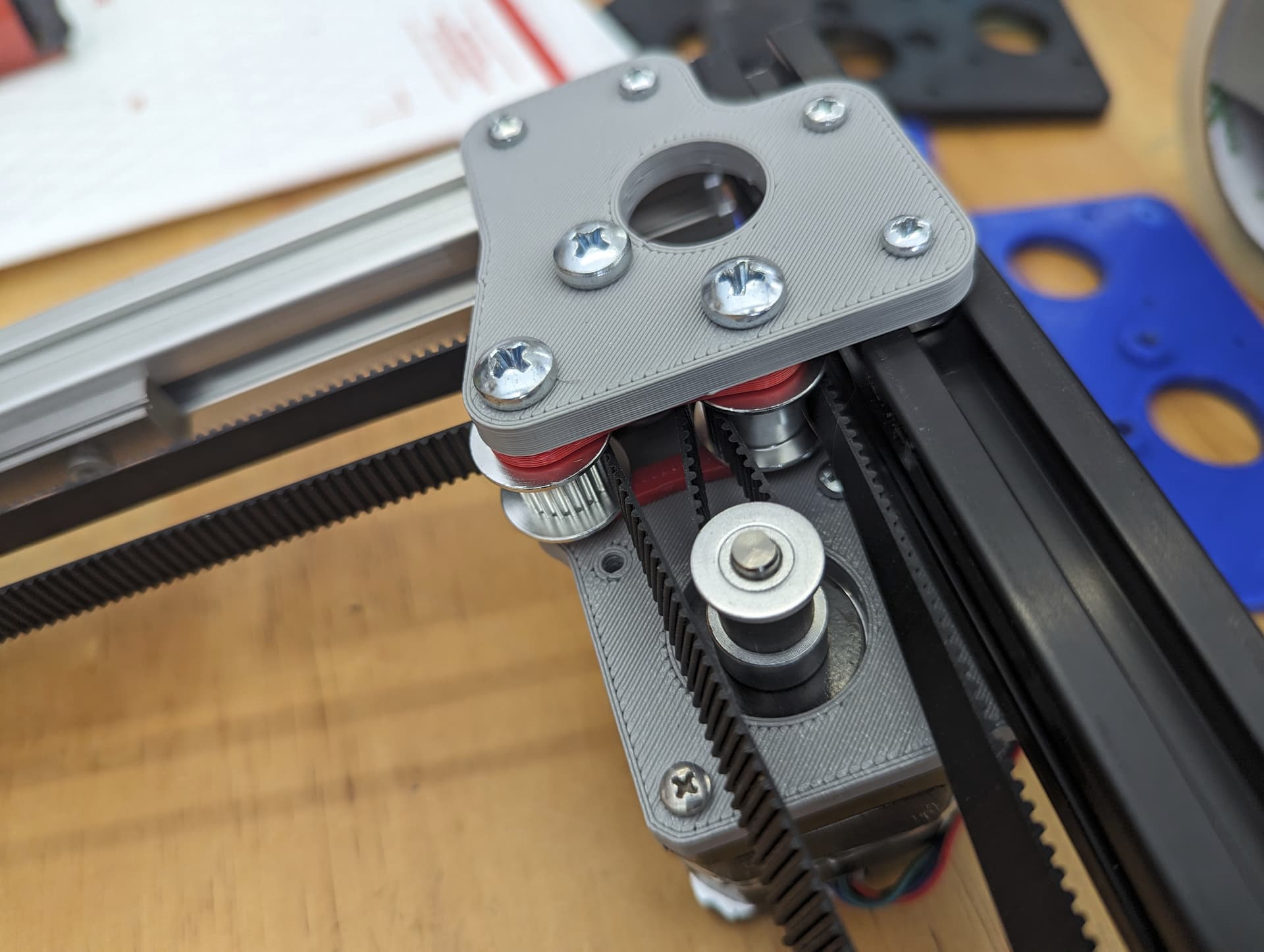
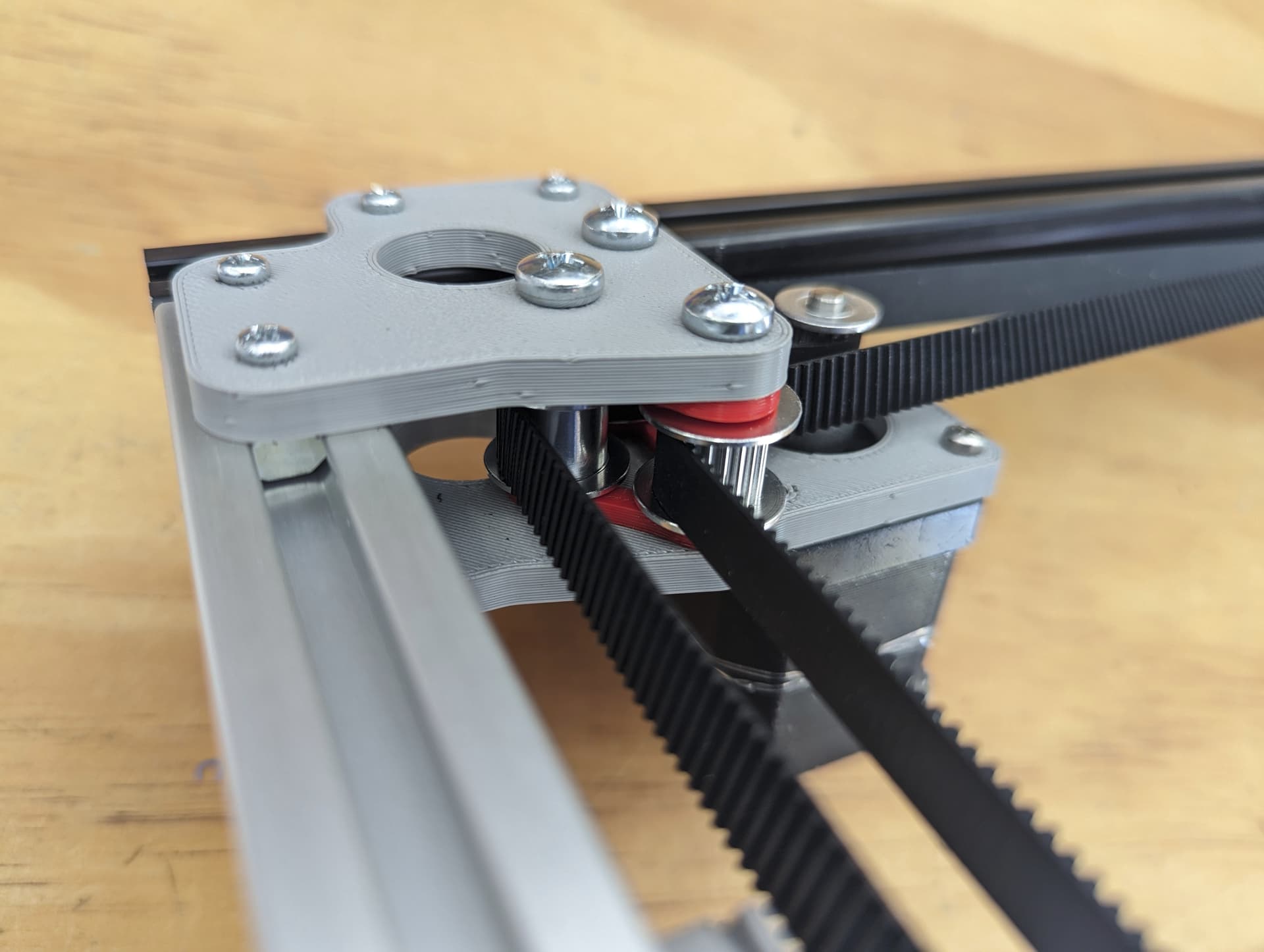
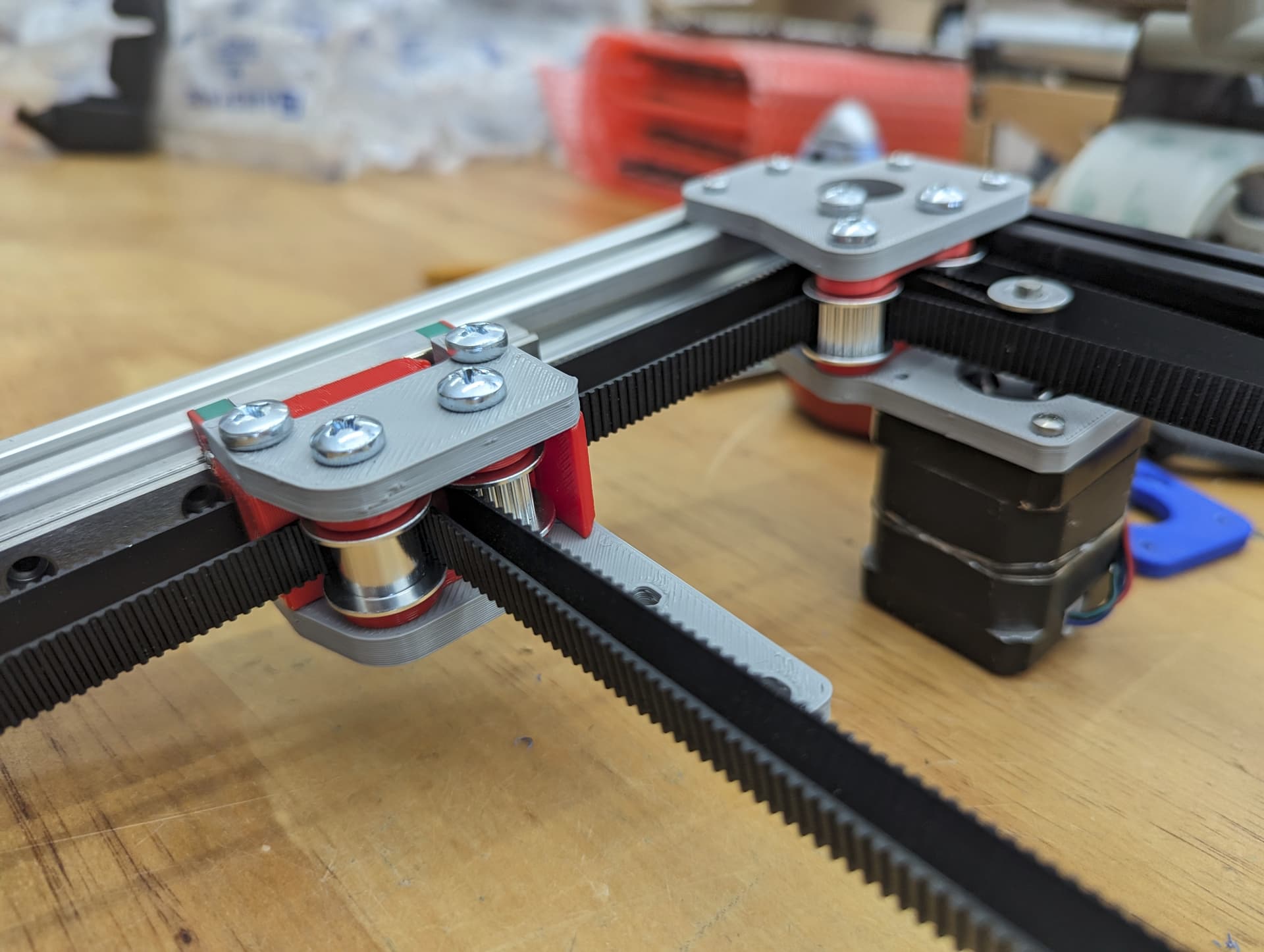
Once we get closer to extruder territory we can all a little more meat to the Truck I think. The printed part is a bit smaller in real life than I assumed…fits great but some walls are a bit small.
1 Like
Damn that looks good! Can we see the whole belt run how you have it there?
I only have the one truck on.
1 Like
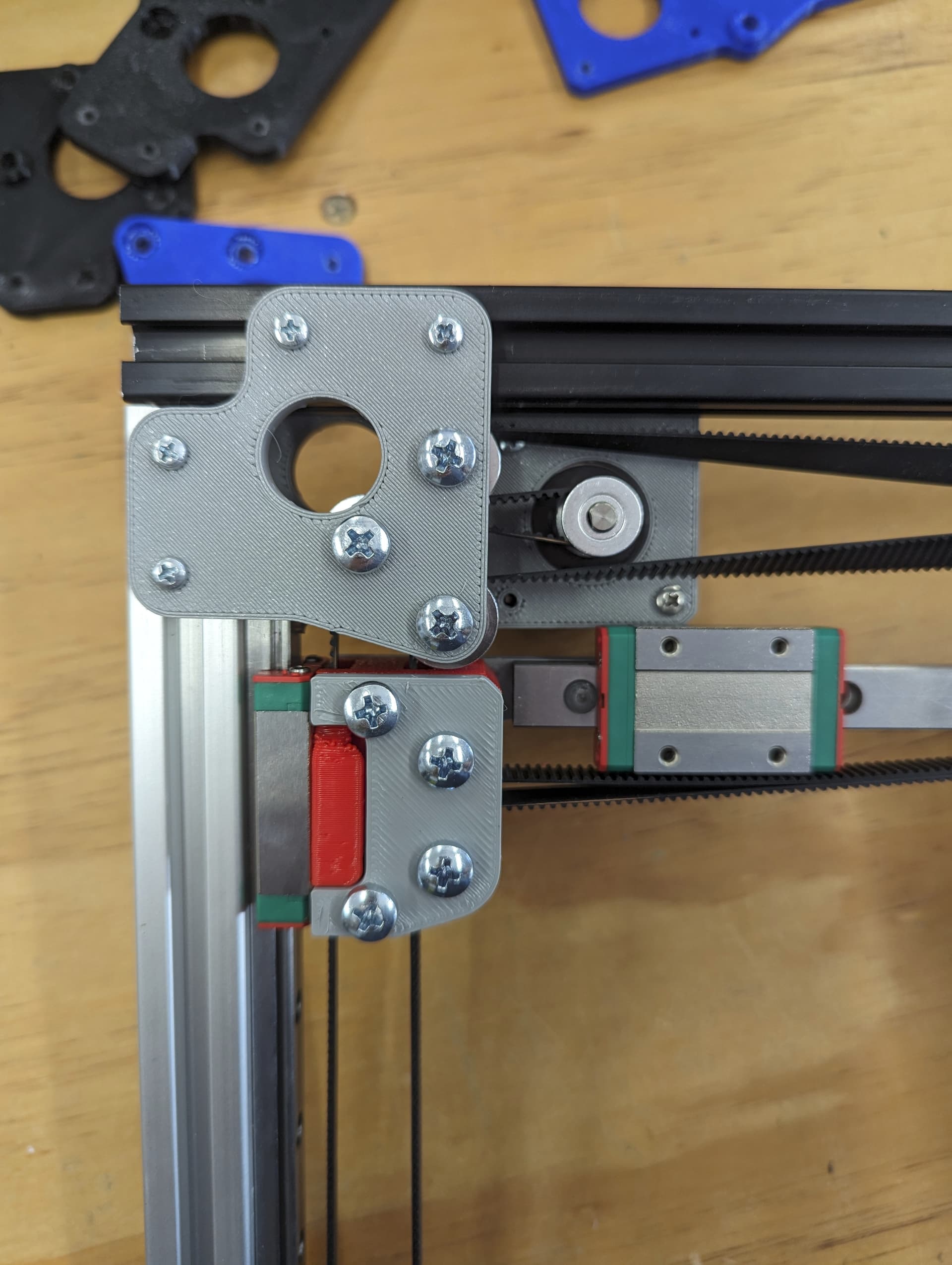
No room at all behind the bearing…perfect fit.
This angle is how I am going to add some beef to this side, it is similar on the other end (front of the build).
this is the most I have,
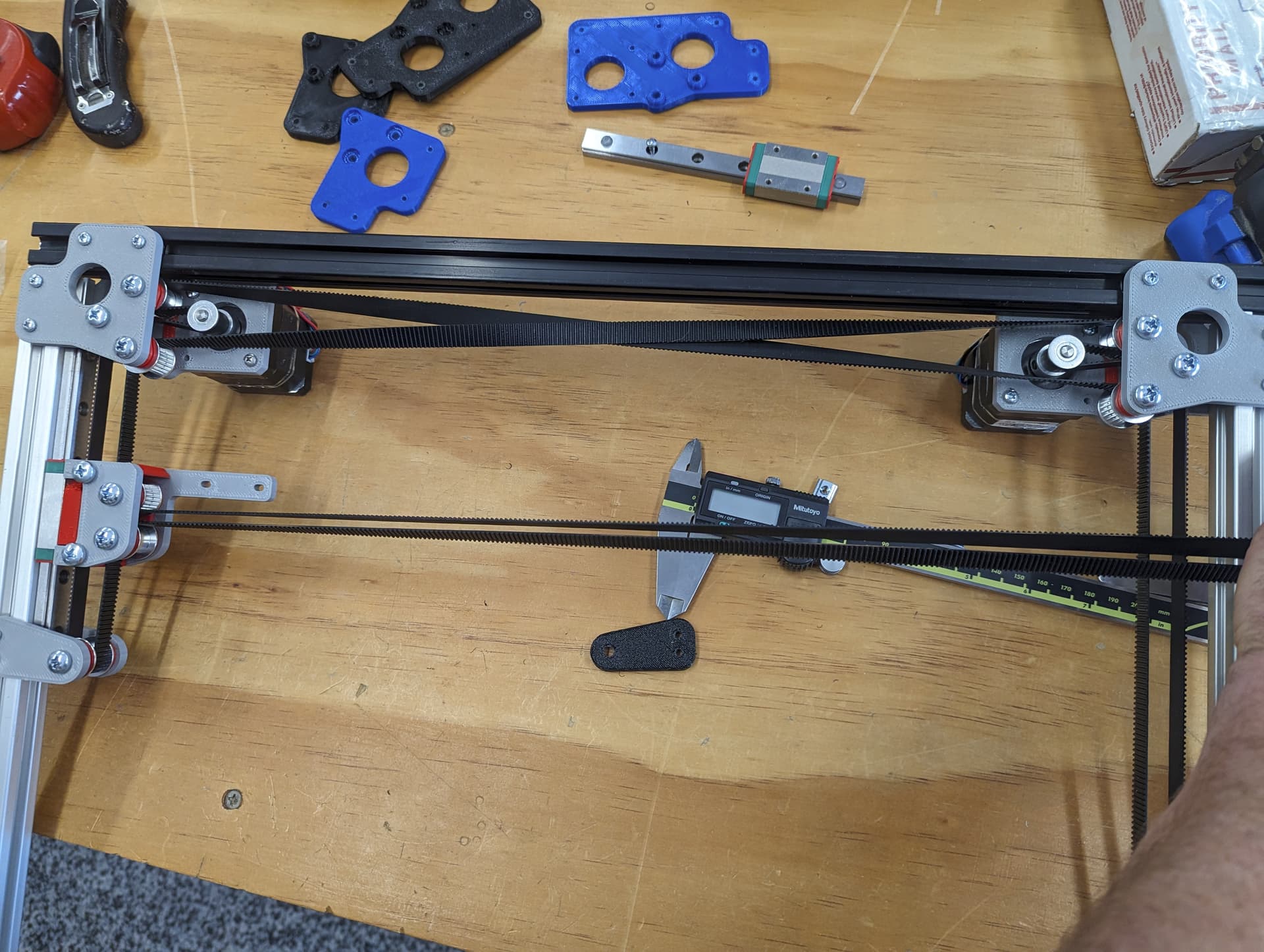
So now maybe whip up the PTFE spacer for the crossover.
Looking at it 3mm plate would be more than enough. I know we all like overkill…but the rail support piece looks real good in 5mm the rest looks way over board.
2 Likes