I am sooooo glad I don’t drive for work anymore. 
290 miles one way for me… But I only have to make that trip one way once ever 2 weeks thankfully. And now talks of us heading back up north again so that will be even better. 20 min drive to the airport once every 28 days then lol.
For me it was 70 miles and I only did it for 7 years (stupid) of course I left that to commute around 4000 k’s per week by aeroplane!
Even now, our carbon footprint is something we are quite proud of, if we ignore that yearly trip to the other side of the globe and back, the impact of which is quite sobering if one thinks about it.
The carbon footprint, while not uninteresting, was introduced by, I think, Shell, to make “normal” people think they could save the environment while big oil happily pollutes the planet.
In a lot of cities the walkable city has also been killed over time and building it back is not that easy.
I drove more than that to Moab, UT for spring break, which is just across the CO/UT border. It’s 550km (350mi) one way. Since EU is made of countries, I would call it smaller and tighter than the US.
Australia is a different story. My impression is that it is huge and less dense on average. But only because most of the population is highly concentrated on the coasts.
True. But we shouldn’t all have to be self sustaining. We do live in society. 40% of Colorado’s grid electricity is solar. As a family, we make decisions to try and put the responsibility on our shared infrastructure to be sustainable. We can’t fix it ourselves. But since we have electrified, it is possible for our government and public utility to go completely rebewable. I have no realiatic hopes that will happen soon, but the electric stuff we bought should last a long time. Hopefully long enough to be powered by renewables.
Yep. Do what one can as one can. My next vehicle will be an electric, every replacement thing like hot water heater or furnace will be moving to electric heat pumps, solar will go on the rooftop (I have room for 20kW easily, just need to get off my butt and fund it).
I almost bought a 2 year old electric crossover last week but the dealer suddenly decided it was worth $8K more than the week before. (It’s still sitting on the lot, good luck with that)
I take the hybrid except when I need to take the F150 to haul stuff (like going to RMRRF). Do what you can when and where you can, and get on with living.
We could really use more balcony solar setups like I saw in Germany. I didn’t know that was a thing.
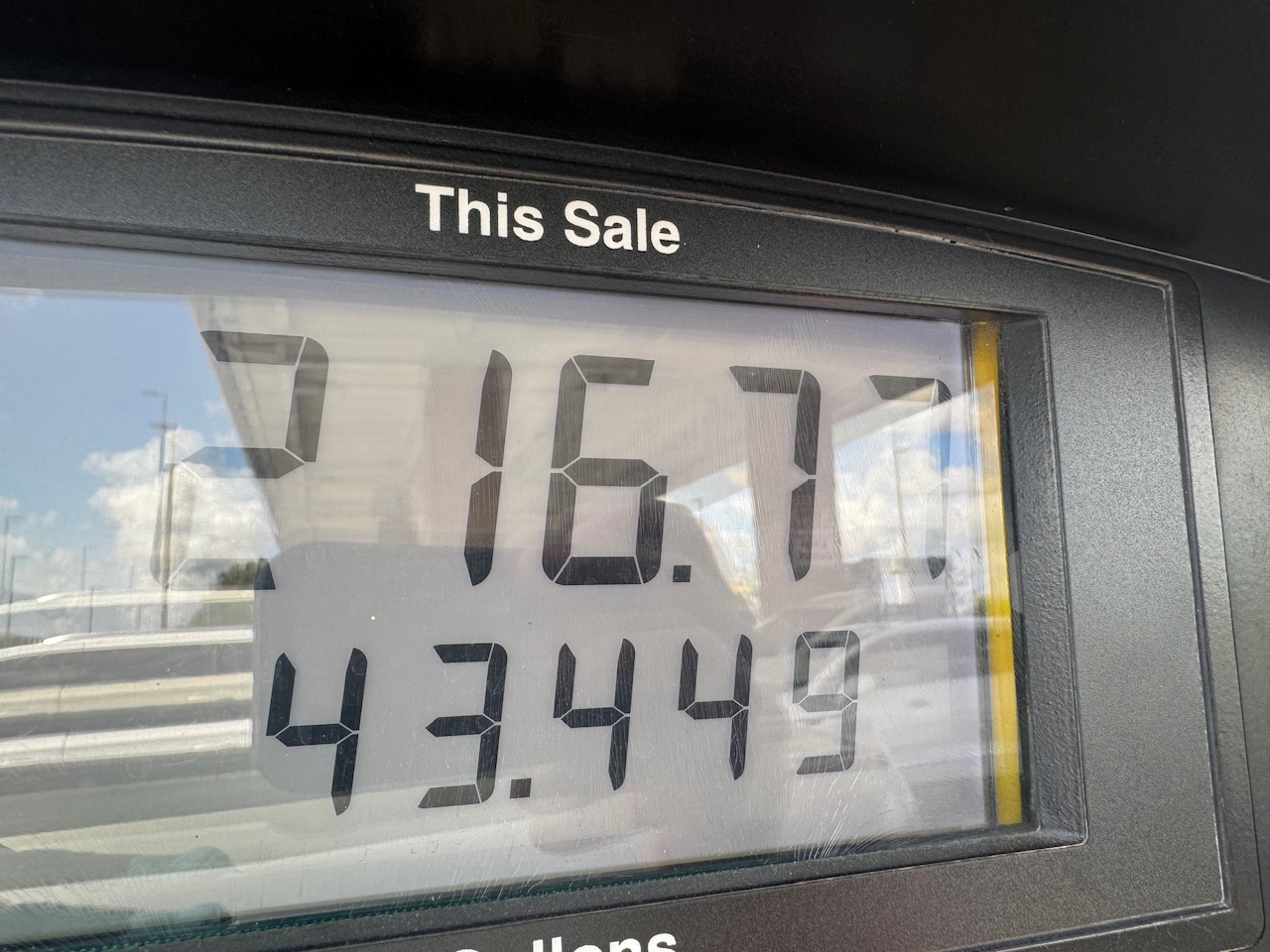
87 octane regular gasoline was $4.15 at the station next to one of my offices this morning. $50 to fill the hybrid up. Was half that when I went to the airport for SMRRF.
Its tough to break out exactly how much of the expense was the vehicle, but last month (Arizona - 1 hot week reaching 106 ° F) I powered the house (2 people) with 2 air old air conditioners, electric range and electric dryer as well as about 1000 miles on my F150 Lightning for about $350. This does include the solar payment, and a portion of the down payment assigned to that month. My solar system is only about 9.7 kW (really wish I had put more panels on but appropriate faces are limited.)
Realistically, I think the 1000 miles on the Lightning came in at about $100 after solar. (Buyback sucks in Arizona, so purchasing a little power each month ends up better in the long run.)
Now I am going to sound like the rabid greenie that I am not - the most efficient vehicle is the one you have - amortising manufacturing footprint over a longer time, but the reality is that the numbers keep changing and I have no clue who to believe.
Verified a few years ago - the carbon “cost” of manufacturing a vehicle was more than a lifetime of emission, and EV’s had a bigger footprint by far, offset by the lower lifetime consumption. Now, thanks to the miracle of the internet, we can find actual data that strongly supports both sides of that argument, so I’m just going to sit on my hands and think about happier times!
My favourite description is that the State I live in (Queensland) is about 2.5 times the size of Texas, Has a similar population to Connecticut, and CT has an area approximately the same as the geographic area of the city of Brisbane.
Of course that’s just a useless statistic, the reality is that we mostly live in Towns with poor public transport, and we are not alone in having governments which have not thought too far ahead for many decades!
Here in NZ for city pricing that’s on the cheaper end but not the absolute cheapest:
NZ$3.65/L for 91 octane, NZ$3.90/L for diesel here. Converted, that’s US$8.17/gal and US$8.74/gal respectively.
That’s quite a historic inversion because we add a fuel excise tax of $0.75/L to petrol while diesel users in light vehicles (under 3500kg) pay a distance based rate of 7.5c/km.
A ‘normal’ price before this was NZ$2.50/L for petrol and NZ$1.90/L for diesel.
We’re also in an interesting spot because we import all our fuels as refined products, now and our current government has slightly dropped the ball on expanding our national stockpile. As a result, we have around 3 weeks at current usage rates and my suspicion is that this is slightly optimistic, given that diesel usage is getting leaned on pretty hard.
As for me, the days are getting shorter and we’re getting more cloud cover so I’m not quite able to run our 2x EVs purely off the solar system at 8c/kWh, ~1.2c/km. Instead about half of our kms are coming from overnight charging at 17c/kWh so ~2.5c/km at the moment.
We’ve been a zero combustion engine household since I sold the motorbike a few years back and I’m pretty happy with that choice. We’ve been lucky to be in a position where that has been easy for us, though, and there are a lot of people here getting it in the neck somewhat, even before considering wider systemic effects like bulk transportation costs that are getting baked into absolutely everything.
The Escape Hybrid is a model year 2009, the F-150 is a model year 2003. I get excellent long-term use out
of my equipment and fleets.
Economic Payback on a~$20k electric vehicle at$4/gallon fuel and a ~15 mile each way commute is pretty short even at 115MPGe
I’m reasonably sure retiring the Hybrid isn’t an ecological disaster, especially if I keep the EV for my usual decade plus and flow the hybrid on to a younger family member.
Most of the production ecological impact is fairly well amortized out at this point, in my humble opinion.
This hasn’t been the case for quite a while and is only true on EXTREMELY dirty grids. Anywhere you see this being posted, it’s best to take a close look at where the info is coming from as chances are it’s pretty suspicious and using some hilariously cherry-picked conditions.
EV batteries were around 100kgCO2eq/kWh when I got into the industry ~15 years ago and have improved dramatically from there, so that can be safely assumed to be a very conservative number. That puts a 50kWh pack around 5tCO2eq.
Manufacturing the rest of the vehicle is around the 10tCO2eq mark, so assuming a complete outright replacement with no recycling, that’s 15tCO2eq to swap vehicles.
Petrol is around 3.8kgCO2/L when burned but a comprehensive well-to-wheels is more like 4.5kgCO2eq/L. Assuming 10L/100km (fleet average here in NZ), that’s 450gCO2/km.
Charging an EV is around 200Wh/km all up. Our grid here in NZ is 120gCO2eq/kWh and dropping, so 24gCO2/km. In Aus it’s around 630g/kWh and dropping, so 125gCO2/km. A very dirty coal-only grid might be as high as 1000gCO2eq/kWh so 200gCO2eq/km.
Payback time, assuming that complete replacement of a vehicle is:
NZ - 35,000km (less than 3 years with NZ average distances)
Aus - 46,000km (around 3.5 years with AUS average distances)
Coal-only - 60,000km
The other thing is that pretty much every grid in the world is lowering their emissions, at least in per kWh terms, so over the ~20 year lifespan of a vehicle, it’ll be improving. Coal/NG energy has already dropped ~20% in China since over the time I’ve had an EV, for instance. NZ hasn’t improved quite so drastically, but it has still dropped little as more and more rooftop solar comes online.
Obviously there’s a lot more to environmental considerations than just CO2 emissions, but that’s the kinda elephant in the room for most of this and the rest can be solved by the various recycling processes that are coming online rapidly.
Thanks for this example. I’ve often wondered about the progress. We’ve been manufacturing gas vehicles in large numbers for 100ish years. Large scale EV manufacturing is less than 20. I must admit that a part of my math is supporting the EV industry but also expecting the industry and the grids to continue the same process of increasing efficiency, safety, and reducing impact as the ICE industry has followed.
I did listen to a podcast regarding EV batteries, and the executive said that (at least theoretically) they’re nearly 100% recyclable. Its just not cost effective. (Apparently some parts would be very expensive to recycle.) Here’s the next area I hope they invest.
Even if you can’t recycle, there’s still usuable capacity when people want to get rid of the car. Reuse them into grid or home storage batteries where energy density is less of a concern and the effort is way lower. Still have to build the logistics for getting the car batteries to a repackaging plant though.
It helps if the packaging in vehicle becomes modularized/standardized. I know of two different individuals here in Colorado who have built off-grid battery / solar cabins using repurposed EV batteries. (Both are EV mechanics)
Hard to do when they’re part of the car’s structure.
Nah, remove the battery and just trash/recycle the metal frame. It’d be like selling your car to a junkyard but either more money/useful for the battery or more valuable if a business is doing it. Remove all the wiring for copper recycling as well. HV Battery (AWD) (Remove and Replace) . Definitely doable by a home mechanic so a shop could make it go pretty quick especially if they have a good supply chain which is the hard part to do at scale when electric cars are newish to the market and last so long.
I really would like an electric motorcycle! But I have not found one yet that peaks all my interests! I still have an 01 Zrx1200 I have had for about 20 years (maybe more)
My VW Tauoreg holds a solid 27 gallons and Diesel also.
The newer VW Tiguan was $45.45 to fill with 12 gallons the other day and I had a $0.45 per gallon coupon…
They already recycle EV batteries (if they can’t reuse them).
Our 2001 prius had enough bad cells that it needed a replacement. OEM wanted a fortune for a new battery but someone in Denver was taking Gen 2 prius cells and repacking them to fit in Gen 1 prius cars. We saved about 60% from the cost of a new battery. That was probably in 2007?
But there are so many EVs and the batteries are so much more valuable, 100% of them will be recycled. They still aren’t going to be able to get 100% of the material back, but they are getting better all the time. It’s just like the way the steel frames are almost completely recycled.
You make a very conservative argument here. But the ICEV isn’t going straight to the landfill either. The payback time is also true for a 10yo vehicle driving for a few more years vs replacing it with a new EV. And, there are quite a few used EVs for sale right now that you don’t need to worry about the CO2 offset for manufacturing a new one. And that is just CO2. ICEV creates a ton of other pollutants like SO2 and ozone.
But we made the same decision Jim did. We decided that we had crossed a threshold and we would no longer replace any cars we had with ICEVs. The subsidies did make us replace our cars a bit sooner and we bought new to maximize the value. But we’ll be buying used EVs in a decade when we need to replace these (and if our kids need cars before then).