Asking because I snagged swing arm again last week while removing gantry (bench is used for multiple tasks). Reattaching is fast but finicky, needed straightening, I’ll check skew and pulloff calibration again if/when it matters.
Cheers for sharing your experience. Curious what type of shite you encountered? Were they all “hw & sw debouncing” on you, and/or inconsistently triggered each time, getting stuck, and/or just failed to switch or work at all?
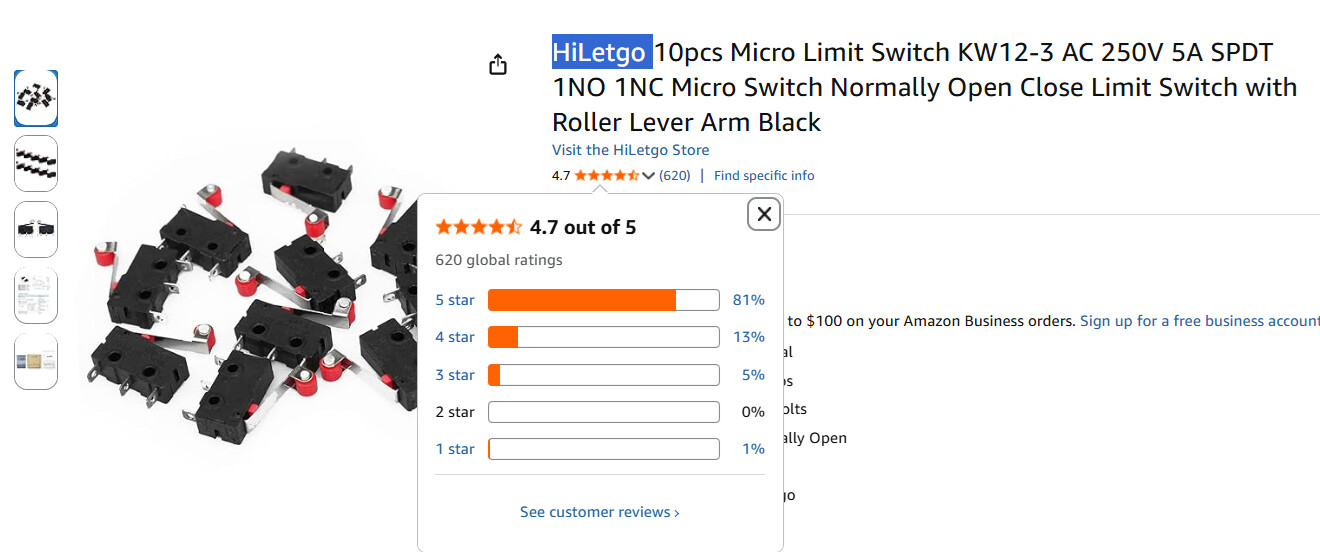
Their reviews are higher than what I’m used to seeing for shite components, they’re also $5.99 for 10, so I’m going to cautiously give them a try as well for another project, and maybe on the LR4 too.
I have a bunch of those switches. “Good enough” is where I’d rate them. They are reasonably repeatable, so the accuracy from home to home will be be closer than you should be counting on for accuracy from a hobby CNC machine anyway, so “good enough.”
This is expected/mandatory for “make-after-break” switching. The idea is that you shpuld be able to put DC Positive to NO and DC Negative to NC and never have a short circuit through the switch. If there is zero delay between NO and NC then there is a moment where there is a short circuit through the switch between the two. This is highly undesireable for many applications.
“Make-before-break” switches, on the other hand will show contact to both NO and NC for a time when the switch is activated or released slowly enough. Again this is by design and meant for applications where common should never be left floating.
We don’t actually care in our application because we only use NC and Common. Either there is contact, or there is not. What matters to us is the repeatability of the switch position when contact opens. If it happens at the same place (to within 0.1mm is good enough) over a large number of cycles, then the switch is good enough.
My analysis of these shite switches is that they’re good enough, until something breaks the switch arm.
Right.. But the switch will stay in the indeterminate “middle” state until I click it again with my finger.
Maybe increasing the pull-off speed would help.
Looking at the LED indicators on the Jackpot board, when the switch is in this state it shows up as a lighter green - same as if it were being fed a PWM signal.