Either one of those is going to be hard to measure for sure. But I would say cutting the line would be your best bet
- Should I use the same method to input all other bits too?
- Does this size change throughout lifespan of the tool?
If you are having fitment issues it can help. But I think I have seen a better way to do this, but I am drawing a blank on what that was right now. Hopefully someone else will come along and have better help for this.
I would think if your tool changes size enough to matter for the cut it should have been in the trash long before that
Because I’m lazy and hate swapping nozzles.
I had in mind being not-that-sharp-any-more-but-still-ok-to-use and probably flexing a bit while cutting because of that?
I’m swapping because it’s new to me, so I’m curious. But I already feel this period is coming to an end…  I might settle on .6 as I don’t really print super quality stuff.
Honestly, anyone who’s serious about long term laziness would switch to 0.6mm, only short term aspiring lazy peeps stick with 0.4mm
I personally try to practice long term laziness as much as possible.
I wouldn’t use a bit like that on something you need to fit together correctly
My kids have me printing those stupid articulating animals just often enough that 0.6 would be an annoyance.
I’m past those animals and indeed did them with .4!
Recently had to print dummy13 number of times, and it was, tbh, one of the most difficult things I had to print. We used .2 for that after many tries…
Sigh… Been using 0.6mm nozzle for months. Sent my smug post earlier. Then, just a few hours later I’m SMH as I swap to a 0.4mm nozzle to print a small trashy toy part.
I gave up on it a long time ago. 0.6 nozzle mattered to me a lot when I had my ender.
But with the speeds of printers today, my prints are “fast enough” with the 0.4 that I rather keep the quality.
Too many models don’t quite work right without a 0.4. Handles, clips, hinges, etc. lots of details rely on the small nozzle to be functional and it wasn’t worth the hassle anymore.
Maybe with a Revo and an auto Z offset calibration or something where switching is nozzles is easy, but I abandoned my 0.6s a while back
I’m hoping with the INDEX upgrade next year on the core one L I can have a mix of nozzle sizes in the machine to switch from without ever actually changing anything.
That would be nice.
I would think another massive benefit there would be to be able to always use PETG for PLA supports and have really nice finishes for stuff without the added time and waste that would be required to do it with an AMS
I think I read somewhere it’s like 4-12 second change time or something like that
Have and like REVO. I don’t need to z offset calibrate between nozzle swaps (sigh… we all know what happens next after such claims…).
Am looking forward to a MP3DP with INDX. Am loosely monitoring how Voron folks integrate INDX.
Heck, yes. Runing these incompatible materials through a changer in a single hotend/nozzel is unworkable. With independant hotend flow, this becomes viable, and much faster tool changes. (dock one INDEX, pick up the next, go back to printing the next thing). Seconds instead of minutes.
Thank you for interlude, but now back to the main topic of this thread.
I’ve run some lines with two bits I used earlier (upcut and compression) and decided to see how width of cutting looks like on both axis, not just one.
I have found interesting thing, which I assume has to do with direction of wood fibers in the plywood I’m using for testing? Please confirm or deny 
Left L shape is up cut bit. Right one is compression but (which actually should also be up cut on this 2mm DOC?)
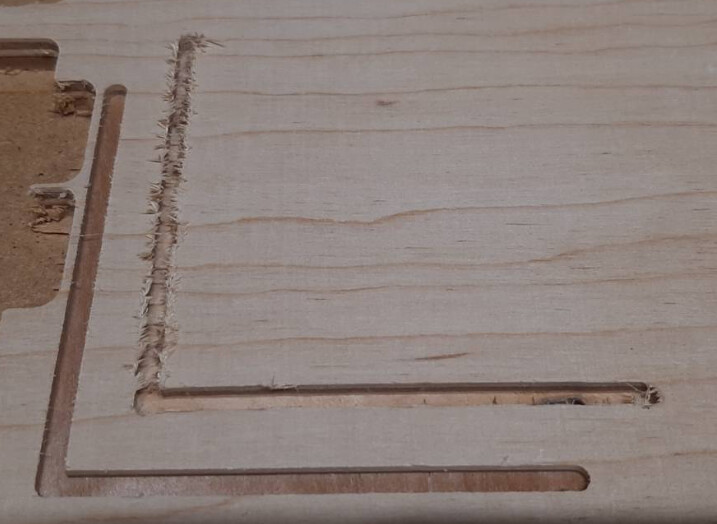
Also, what kind of wobble can this little bump be? Nearly nonexistent on upcut L, but huge on compression bit.
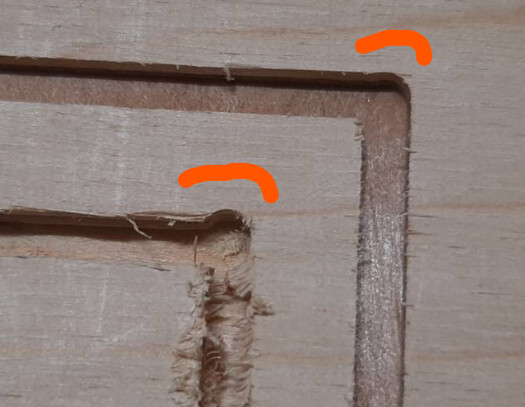
That problem with the upcut will allways be like that unless you can plunge the bit into the wood past the compression part of the bit, which migh be around 10mm. see this video for explanation
I think I understood principle of those bits - that’s why I said the above.
Let’s clear this up. Let’s assume I have a compression bit: upcut 5mm, downcut 10mm. Perfect for cutting 12mm material on one pass (if possible for given machine of course).
So, are you saying that 5mm upcut part will not work as up cut if plunged only 4mm deep?
Your compression bit could be dull/have imperfections? It’s crazy how clean of a line a fresh blade gets you, but also crazy how easy it is to dull one..it only takes a fraction of a second at high temps and she’s a goner
So I am back in this thread, as I need advice on the same thing…
I just noticed, when I move core on X axis, right-lower (looking from the back of LR3) bearing is not spinning on the conduit. Which screw should I tighten to pull it back to the conduit?