Figured I start a new thread here to not highjack someone elses!
I’m about to start building the table for the LR4 based on the $200 build guide.
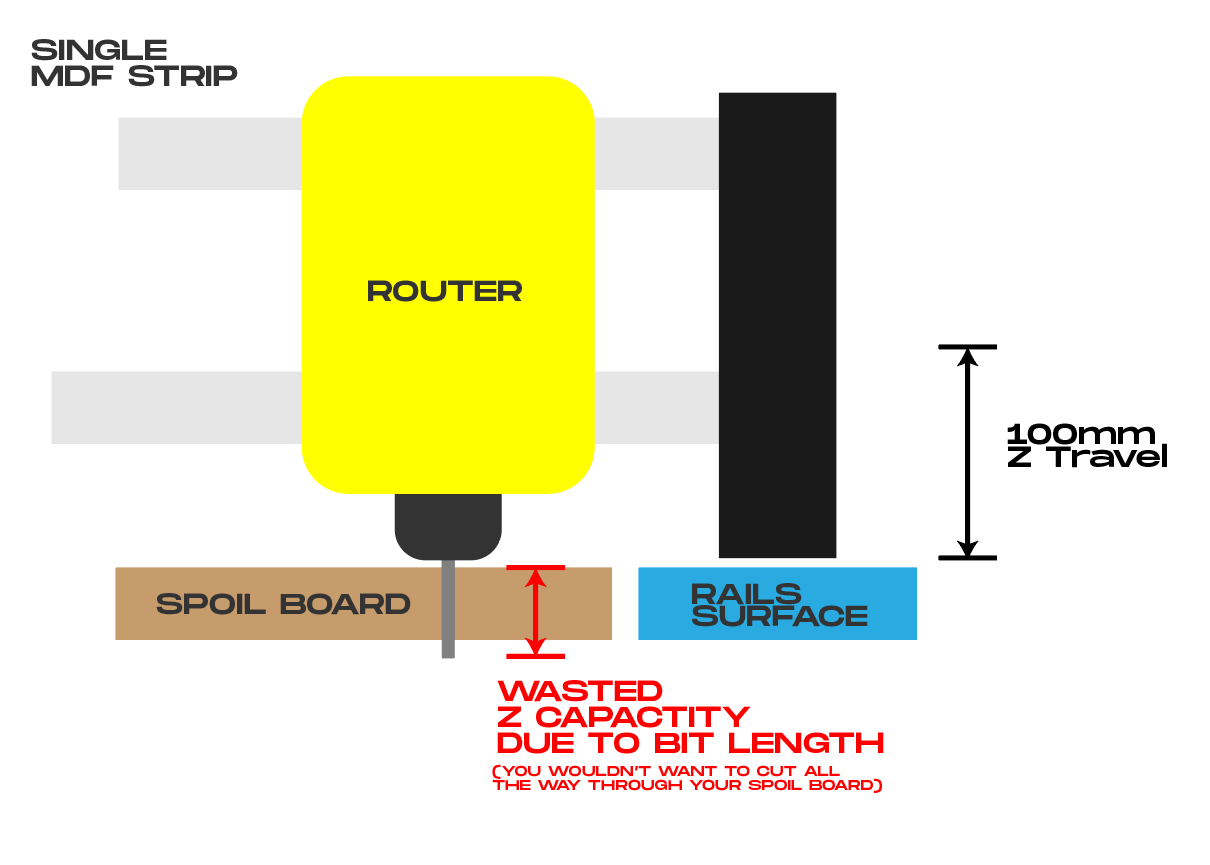
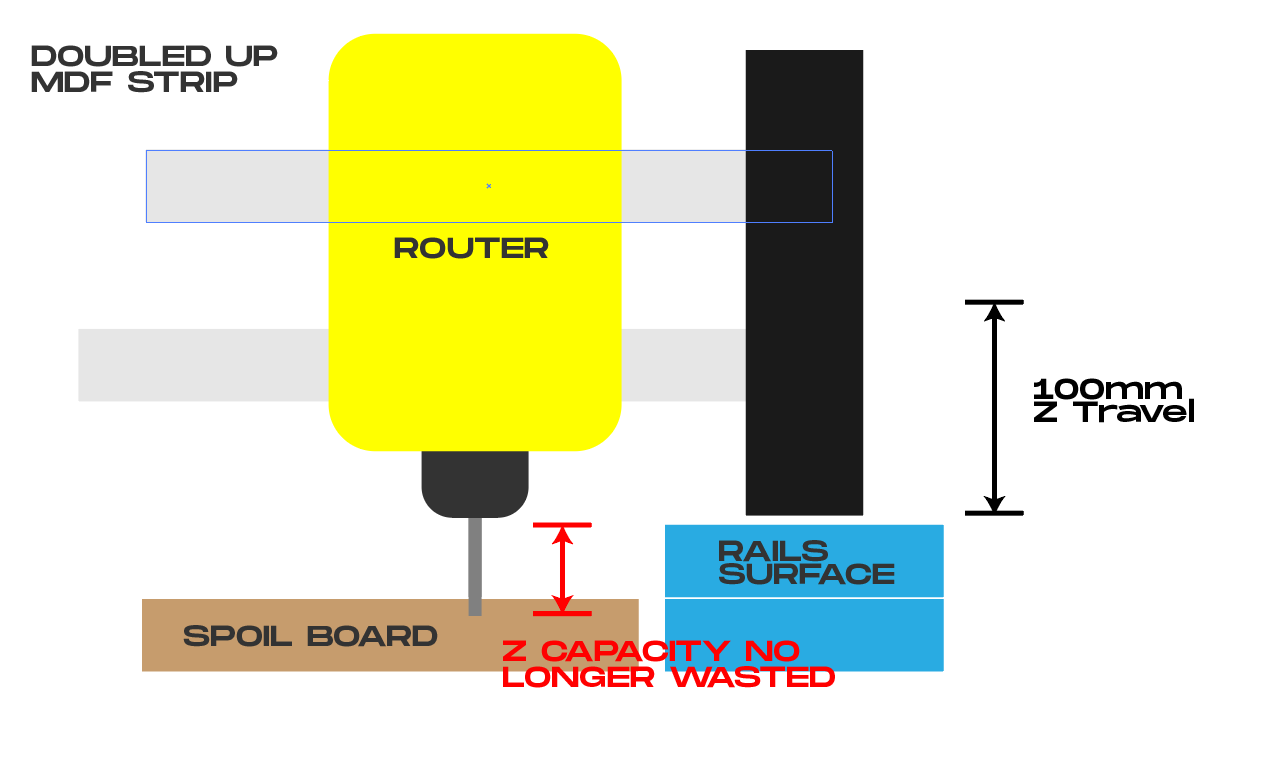
I want to maximize the thickness of stock I can mill, so one of my questions is if I could safely raise the rails by 3/4 of an inch by doubling up on the mdf strips, without loosing any through-cutting capacity.
At the default setting of “rails” and spoilboard all being the same height, how close is the collet to the surface of the spoilboard? It sounds like it will touch the spoilboard, which I imagine is not something you would ever really need since most milling bits will stick out at least 3/4 on inch, so couldn’t you just raise the rails by 3/4, gaining 3/4 of stock height (since your not “wasting” z latitude “beneath” the spoil board)?
That depends somewhat on the router being used, and how it is mounted on the core. The best answer would be to build your machine, and then measure it..
Usually the collet is some distance above the spoil board at ZMin. As noted above, that distance may vary among different builds
Not necessarily. I have mills that range in “stick-out length” from 1/2" to 1.5" . Some V-bits are very short, and larger (1/4") shanks can be much longer. If you always use the same bit, you can standardize the height of the router collet above the spoil board, but changing bits for different uses will require varying the collet height.
Yes, raising (and lowering) the rails (and running surface) using additional layers of MDF to optimize the amount of Z travel is a thing. In general, for through cuts, you want ZMin located such that the bit is just cutting a few mm into the spoil board. This adds to your build stability.
Note that your spoil board may have height variations (warping), so adding a few extra mm of depth cutting into the spoil board may be prudent.
Thanks for explaining!
That makes a lot of sense!
So basically best approach is to build it and see how low the router is, and then go from there.
Either way adding or removing the extra plate should be easy enough, so not like I’m stuck to one option.
One other question regarding something I was just talking to @vicious1 in an email - and he recommended asking here instead:
I want to the ability on my table to work on end pieces as well for joinery etc. I asked about extending the table, but he said it’s better to keep the y length as short as possible, so instead of extending the 8ft+ table by half a foot or so it’d be better to shorten the table top, as it’s okay for the work piece to hang off a bit, if I’m working on a full sheet.
About that, why is it better to have a shorter y rail length? Is there more room for inaccuracies due to the belt getting longer? Or the rail not being perfectly straight? Or what would be the main downside & cause to make an extra long y axis?
Mostly it is because really long machines are unwieldy for your shop space.
Not really. Belt stretch is a (minor) thing, so you will want your belts to be tensioned to about the same tension and ideally be from the same lot of belt.
We have community members that have built vertical clamping access areas into their machines. I don’t have any links handy to the build threads, but hopefully the rest of the community can come in and give you links to those.
I measured that when the rails and the top of the spoilboard are at the same height, there is about 16 mm of clearance below the core. Since I want to machine aluminum with a shorter end mill, I would only raise the rails about 5 mm above the spoilboard height. On my LowRider 4 the Z travel is around 110 mm, so I still have plenty of movement available.
In my case, the bottom of the core is exactly at the same height as the bottom of collet of the router.
We know that a shorter x axis is more rigid and that rigidity helps with minimizing deflection under load. With respect to the y axis, you can go longer if you want… At some point if you exceed standard stock sizes the challenge is joining the extra length and keeping things level/tram, and basically true. What you have described for extending the y axis been done and should work. Looks like Makerjim mentioned the belts becoming unweildy also.
Oh okay. If that’s the case with mine, it shouldn’t make much sense for me to raise it much then. Some of the 1/8th bits I have are only about 1in long.
What router are you using? The makita?