I’m getting ready to wire up some stuff for my LR4 and wanted to get the collective experience of everyone and verify that what I’m doing seems safe and sound.
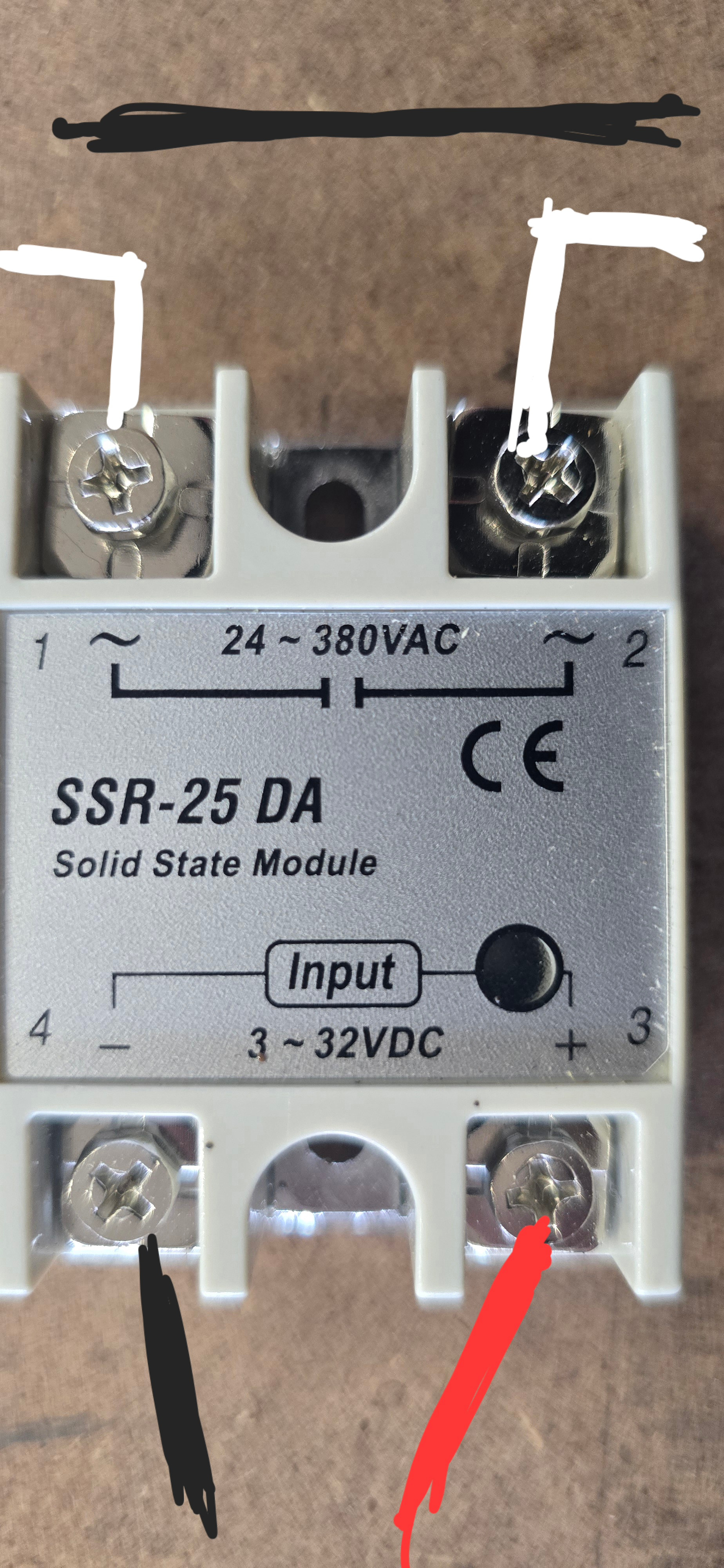
I bought this relay (CG Solid State Relay SSR-60DA DC to AC Input 3-32VDC to Output 24-480VAC 60A Single Phase Plastic Cover).
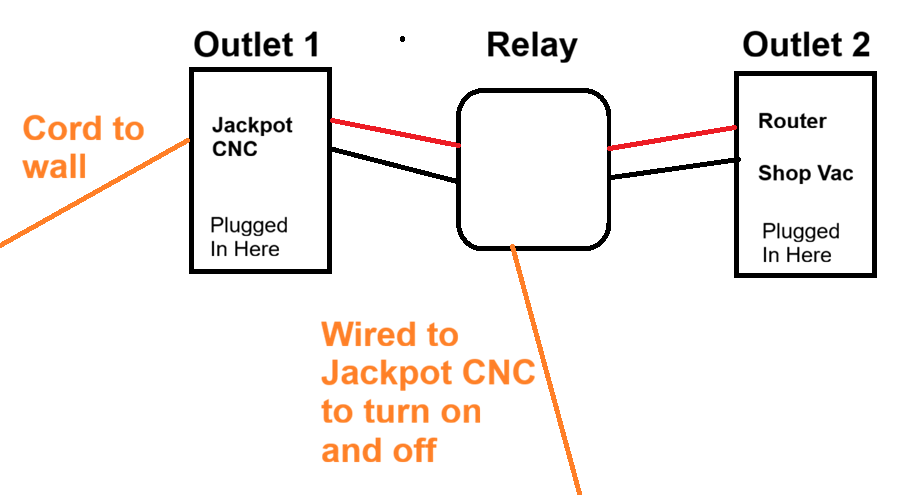
My plan is to have two electrical outlets, wired together with the relay in between. The first outlet will have the Jackpot CNC in it and will always be powered. The second outlet will go to the relay then to the first outlet.
Does this seem sound? Here’s a poorly made diagram in paint if my explanation up top wasn’t good enough.
A relay does not work for new Makita routers, at least in the EU. If they turn off by cutting the electricity, you have to manually trigger the on/off manually again. Don’t know about yours though.
Power comes in from the wall on pin 1 then out to the tool on pin 2. White is the ac wire and the black is bypassing the relay but part of the same ac cord
Red comes from io on the jackpot and black goes to the corresponding - on the jackpot.
At least that’s 110v in the US.
For your case wanting to power the router and vac, check amp draw and max wattage. I would think you should be fine, but i don’t know what your machines are actually pulling.
@spsully2582 - I respectfully suggest switching the colors you use on the top of the image. Generally (in my experience in the US) the black wire is the hot wire, and the one you want the relay to switch. White is the neutral. While wiring as originally diagrammed will stop and start the device downstream of the relay by preventing returning current on the neutral, there will always be power flowing to the device so terminals in the circuit will be energized and at risk of shorting out or causing shocks. By switching the black/hot wire, that danger is removed..
I agree and that was a good catch. I would also note for anyone trying to do this, that not all wiring in all houses was done to the same code and same level of skill. While both will work because AC, it doesnt mean your black or white is the neutral. With this being in a power cord, then @ttraband would be right 99.99999% of the time.
Thanks! The colors I’m not fussed about, as I have enough understanding of wiring electrical that I’m not worried about it. I’ve wired a few outlets and light switches and such. I just wanted to make sure that it would be safe the way I have it planned out.
Interestingly enough, the relay has no ground. Should I just run the ground on the plugs that are going into it to something metal in general?
Does it need to be something metal that’s sizeable? Or can I just run the ground to a random metal screw screwed into the wood I’m mounting the whole thing on?
Yes, ground it to the metal chassis somewhere, but don’t connect it anywhere to the DC side directly. That can create ground loops amongst other things.
When looking specifically at the switch there’s no need for an earth because it’s all isolated. If you’re running the SSR in a non-conductive enclosure, there’s no need to earth anything on the SSR itself, you just need to make sure that the ground is continuous from your input through to the load, in this case the router. If you were controlling something with no earth (like some LED lights or an isolated power supply) then you wouldn’t need to bother with this.
If there’s any metal exposed that may become live in case of a damaged wire or anything like that, that’s what you would earth. Examples of that would be a metal enclosure, an exposed metal heatsink sticking out of a plastic enclosure, etc. It’s good practice to earth everything at a star point such that it’s obvious and easy to test for when the enclosure earth is disconnected. It’s also good practice to retain cables such that a connector or joint failing can’t lead to anything bridging across the isolation of the SSR.
Don’t worry about earth loops, for the most part.
No, it’s an isolated piece of metal. It may need to be earthed if it’s exposed, but it’s not specifically an earth connection.
Just throwing this out there, but I’d recommend putting each load on a separate SSR.
The dust collector may still be pulling dust after the router is turned off. Your gcode could have separate steps for turning the dust collector on at the start of the run, then turning the router on. then turning everything off in a delayed fashion to give the dust collector time to pull the rest of the dust through the pipes.
Latest version of the jackpot has 4 outputs. I don’t think any of them are used for the ‘standard’ build, so all 4 should be available.
I also wouldn’t worry specifically about start current, if the SSR is rated appropriately for the steady-state load then a single pulse on startup isn’t likely to cause any issues. I wouldn’t want to do a ton of repeated starts, necessarily, but one won’t hurt anything.