… and no, it’s not LocTite (although that’s a word that should always be used in the same sentence as grub screws)
The motor shafts have a flat section as well as a rounded section. You want to align one of the grub screws with the flat section and tighten it up, then tighten the second screw against the rounded section. This prevents the shaft from slipping in the gear, even if one of the screws becomes just a little bit loose.
If you tighten the screw against the rounded section first, you may think the screw against the flat section is tight, but if it is slightly misaligned when you tighten the other screw first, then when the shaft slips slightly, that screw can be completely loose (no longer seated against the metal shaft.
Even worse would be if you tighten both screws against the rounded section, then the shaft could slip and turn even further than if the screw on the flat section was only loose.
This is fairly obvious to anyone with a mechanical background, but after reading some threads in this forum, it seems like there’s definitely a few people who don’t necessarily have that background.
In the spirt of seeing confusion caused by grub screws vs set screws, I find myself compelled to point out another “technical term” clarification that has been weighing on my mind.
At the risk of being that guy, we are actually requesting people use threadlocker as the technical term to make our lives easier and less problem prone.
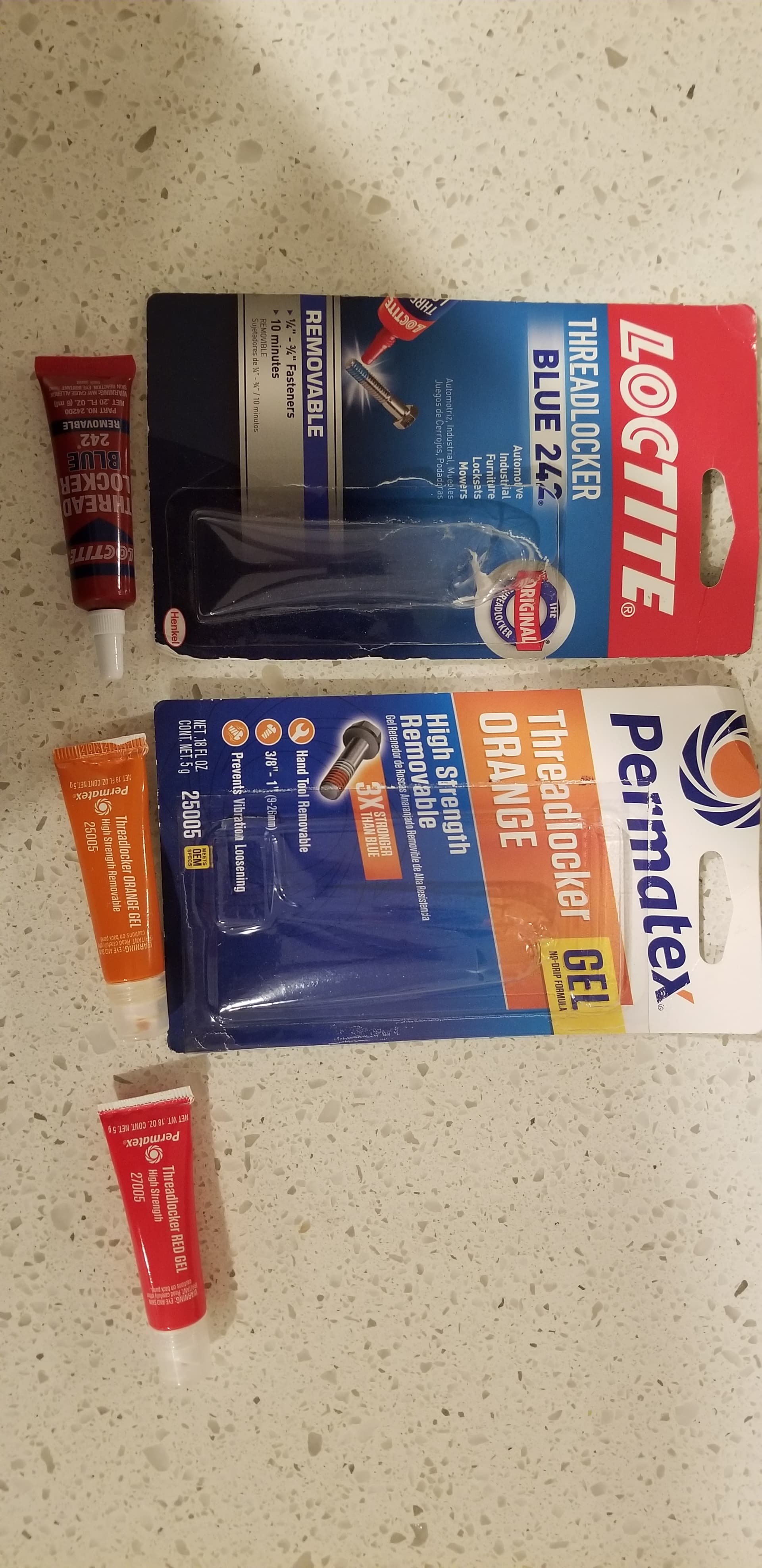
Loctite is probably the most widely known brand of threadlocker and therefore I do not want to be misunderstood, and thought to be correcting Bartman. Permatex is another popular brand in the states, with Orange as a third type/color.
With that said, Loctite as a brand, and a specification of “blue”, very well might be enough specification for our machines. But know going in that Loctite has different “formulas” of blue, and you supposedly you will not find any respectable RC helicopter pilot putting 242 on their helicopter blades. Everyone uses 243 for whatever reason. I personally don’t know the science behind the logic, just was warned my more than one veteran when I got my first heli, to use 243 and not 242. Red normally needs heat to break free, or an impact/torque tool that I’m pretty sure we don’t want to use on our machines, and I definitely don’t want to use around the pricey machined aluminum parts of the heli.
I took their advice because having sharp carbon fiber blades heading towards my head seems like something I want to prevent.
I hope that helps people more, than causing more confusion.
As an alternative to the traditional blue/orange, loctite or other branded version of threadlocker, I have heard clear nail polish can work in a pinch as well.
Just to further be “that guy”… The steppers that Ryan sells have flats. Not all do. If people source their own steppers, this is something to watch out for.
Also, when sourcing pulleys, there are pulleys with two setscrews (grub screws). My understanding is that these are preferred for use with steppers that do not have flats.
In these sizes. I’ve only seen steppers with flat motor shafts and pulleys with two grubs. I’m sure others exist. But I’ve always seen flats and 2 grubs on all the printers and CNCs I’ve made.