I’ve been kicking around an idea for a while, and I’d like to see if the community is interested.
One of the questions that comes up over and over is:
-
Are metal strut plates actually better than MDF?
-
Does adding more printed braces make a measurable difference?
-
How much does gantry length really affect performance?
-
Is a heavier spindle worth the tradeoff?
-
Does PET-CF, ASA, PLA, or another printed material matter and on which parts?
Everyone has opinions, but we don’t have much actual data.
The goal of this project is to change that.
Rather than asking “How fast can your machine cut?”, I want to build a community dataset that shows which design choices actually increase machine stiffness and usable cutting performance.
The idea is simple:
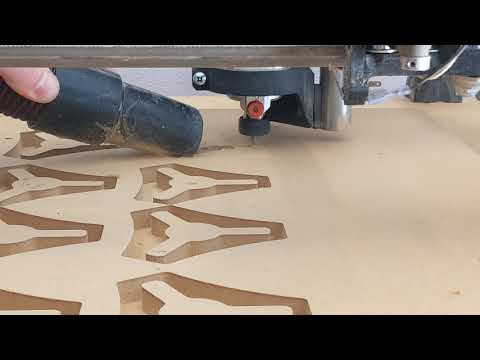
Everyone runs the same Hog-Out test generated with Vector76’s excellent test pattern generator, using the same basic cutting parameters, bit type, and material. We then record both the machine configuration and the results.
Each machine starts with an easy feedrate and increases in fixed increments until the machine reaches its practical limit. Think of it like a volumetric flow test for a 3D printer—the goal isn’t to win, it’s to identify the point where performance starts to fall off.
For each submission we’d record things like:
-
Gantry length
-
Tube material
-
Strut plate material
-
Number of printed braces
-
Printed part material
-
Router/spindle model
-
Bit stickout
-
Feedrate ladder results
-
Highest clean feedrate before failure
-
Failure mode (deflection, chatter, skipped steps, etc.)
Over time, we should be able to answer questions like:
-
Does ⅛" steel outperform ¼" MDF, and by how much?
-
Is the difference larger on longer gantries?
-
How much do additional braces actually help?
-
Is there a point of diminishing returns?
-
Which modifications provide the biggest improvement per dollar?
I’m not trying to create a scientific laboratory test. I’m trying to create a repeatable community benchmark that anyone with a LowRider v4 can run in an afternoon.
I’ve put together a draft testing protocol and data sheet, but before I ask people to start cutting I’d really like feedback from the community.
What would you change?
Are there variables I haven’t considered?
Is there a better way to measure performance while still keeping the test simple enough that lots of people will actually participate?
If we can get enough submissions, I think we’ll end up with something that’s genuinely useful—not just for people modifying existing machines, but for anyone building a new LowRider and trying to decide where to spend their time and money.
I can’t load the document directly here so I made a drive folder and made it shareable.


 , just not sure how to evaluate one machine/builder against another.