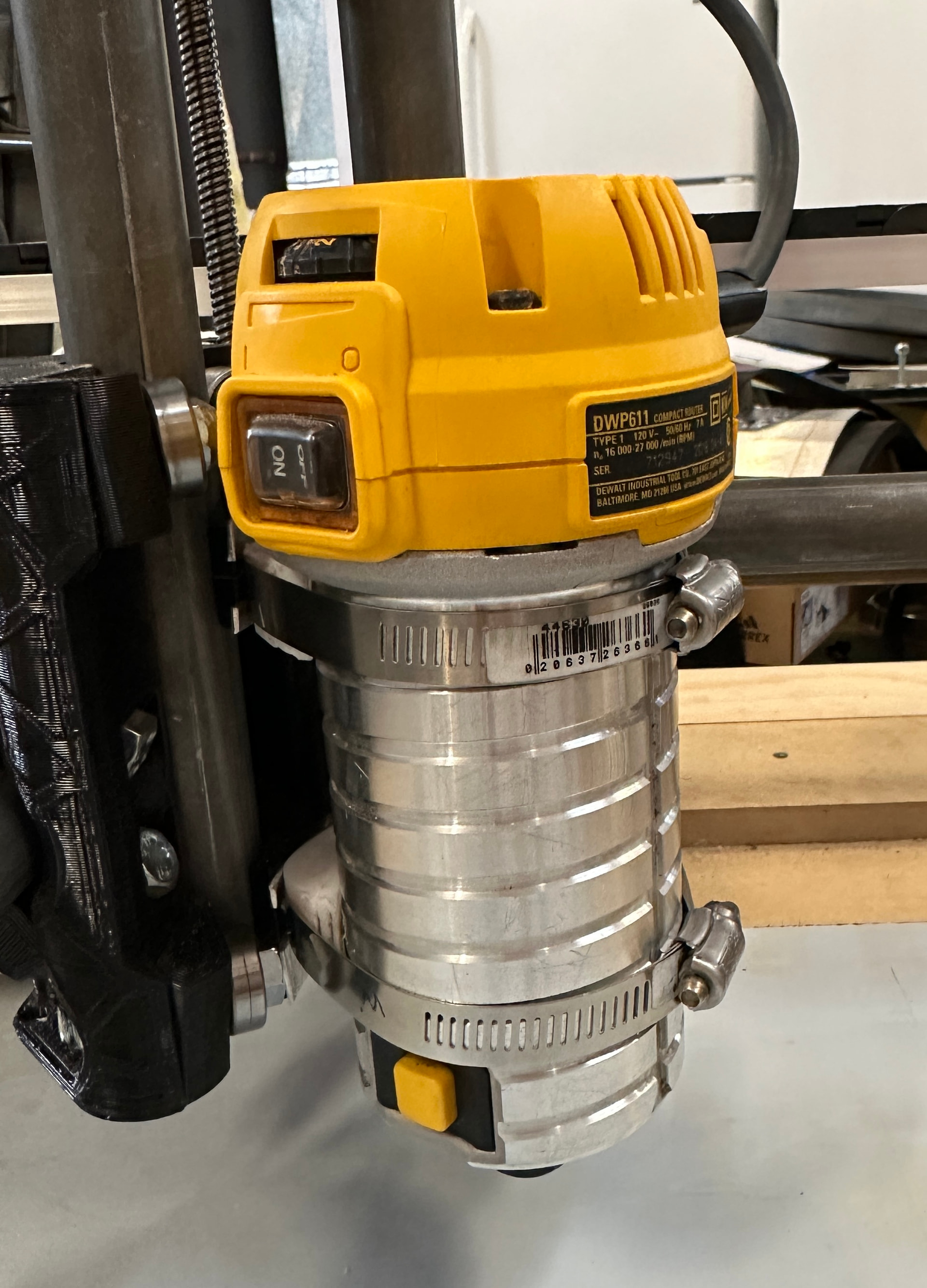
One day I was about to use my machine when I saw that both parts of my Dewalt 611 tool mounts had snapped. This is a problem I have had with other 3d printed parts that have to hold tension – they stretch and snap. That’s why I like hybrid designs combining 3d prints with metal and other stronger material. The MPCNC itself is a hybrid design.
So I crudely lopped off the bands of the Dewant mounts and and used auto hose clamps as shown. I left parts of the printed tool mounts and spacers to interface with the two metal tubes. Looks kludgy but works great. The worm screws of the hose clamps never loosen. A benefit is that it is very easy to tram the system as the hose clamps open quite a bit so I have lots of room to insert shim.
I could now cut better looking aluminum clamps but they would be harder to shim to get the motor trammed. So I will stick with this.
My only issue with the clamps is that there is no place to mount the dust shroud on my LR4. But I will probably do it with at least the upper one. I can try to model a connector or something for the dust shroud. This is a great solution though.
The only reason those clamps would fail is just from being overtightened, or a really bad crash. Either way, the printed parts are safer. Those clamps will not break so the next thing to break if you crash or overtighten now would be the Z mount plates which are harder to replace.
And I believe that is what happened with mine. For some reason, the z dropped what too low and slammed the router bit into the wood taking a huge DOC. It was just a fluke too. I’ve ran that same operation several times before and after.
Ryan makes a good point. In my case the printer has to live in my Tucson, AZ garage which gets very warm. I had to tighten the clamps once or twice and I may have overstressed them over a few periods of stretching and tightening. So if this is not a general problem one should stick to the printed ones. It made me think, as a car guy, that we need torque specs and we should suggest a torque screwdriver (they exist and are not too expensive).
Due to my harsh environment , however, I am sticking with my auto clamps. I may grind a partial slit in them to create a weak point in case of a bad crash.