Hello.
Is the processing precision of the LowRider V4 ±0.05mm?
I would like to know the basic specifications such as how much precision it can achieve and the power consumption.
I’m not sure what you mean by the ‘V4 0.05m’?
Power consumption will be dominated by whatever tool you’re running, maybe 40-50W maximum for the LR4 motion platform itself and controller.
The amount of precision the machine can achieve is down to what you’ll be cutting, what tooling you use and how accurately you assemble/calibrate the machine. It is very difficult to define precision usefully in a single number, but repeatability of the motion platform itself should be below 0.1mm.
Excuse me, I am talking about the machining accuracy of ±0.05mm.
1 Like
And Jono gave you an answer. With a finishing pass it’s pretty accurate, but it depends on the build quality, material etc.
What do you work with that you need sub0. 5mm accuracy?
I mean: you are not expecting a hass or tormach cnc mill level accuracy from a sub700usd-ish cnc ?
The machine will move that accurately, but even measuring +/-0.05mm reliably is difficult.
What application do you have that you would need that accuracy? That may let us provide better feedback about whether the LR4 is a good choice or not. The concern is that when working with wood or plastic it’s seldom important to reach those levels of tolerance, which means you may be asking about metals. The LR4 will machine aluminium but that’s already getting to a point where the accuracy you can achieve will be much more related to your spindle, tool sharpness, chip control and CAM paths, rather than the machine itself.
I suspect that with a lot of care and time I could get an LR4 to make an aluminium part with a single critical dimension at +/- 0.05mm. I very much doubt I could get it to do that repeatedly over and over or hold that tolerance on an entire complex shape, so it really does just come down to why you need that specification 
Power consumption is low on the motors and control board. Power supply is 60 watts but I’d doubt we are using close to that. The big consumer will be the router/motor you choose for tooling. Example a dewalt router is about 1300 watts a hour
Accuracy depends on how well you build it. What quality PLA, how good is your printer if you are printing the parts. Was the pipe you got for the gantry 0.05mm accurate, etc etc. but the biggest thing is wood isn’t 0.05 mm accurate. For example where I live depending on the season a wood panel and swell Upto a 1/4 inch. Daily fluctuations is going to be bigger than 0.05 mm
Now aluminum is different, but there’s more factors that go into aluminum accuracy. Now if you are worried about repeatability such as a multi-cut job or doing carving style projects on the cnc this is definitely accurate enough for that.
I’ll put it one last way  if the 3d printer and materials you use to build it aren’t going to be accurate Upto a human hair (mind you that is the accuracy 0.03-0.06 is a human hair) chances are the machine won’t
The maximum accuracy will vary a bit depending on the stepper drivers used. If the build is using TMC2209 drivers, the steps per mm is 100 for X and Y and 400 for Z meaning the accuracy is 0.01mm for X and Y. The problem is there are many things that will combine to degrade this accuracy like deflection of the bit, runout, and imperfections in the build. I don’t remember anyone on this forum taking a deep dive with precision materials to see what real world accuracy can be achieved.
You might search the forum for circuit boards. The posts might include the minimum trace thickness they were able to achieve.
As for wattage, based on the power supplies V1 sells, V1 machines uses less than 150W. You will have the power drawn by the the router and possibly a vacuum on top of that.
Don’t forget micro stepping, and interpolation. Of course I agree, 0.01mm is beyond anything I would ever promise, because I do not have the ability to measure that accurately.
I would say with our hardware, a perfectly set up machine, quality end mills in a spindle with a quality collet, and spot on CAM (or extremely light cutting loads) you could reasonably get around +/- 0.2~0.3mm in a machining scenario on smaller parts in aluminum. With a little teasing with offsets or stock to leave in F360, could maybe manage +/- 0.1~0.2mm. If you need below +/- 0.2mm every time making parts, I’d look at a different machine solution.
2 Likes
What to make?
Good question.
I like fighter jet combat flight simulators, and I’m thinking of making a 1/1 scale cockpit frame and ejection seat for an F-16C.
I have DXF data and 3D data for the data, and I plan to use lauan plywood as the main material.
As for the ejection seat, I’d like to make it out of a 4 x 8 foot 3 mm aluminum plate, if possible.
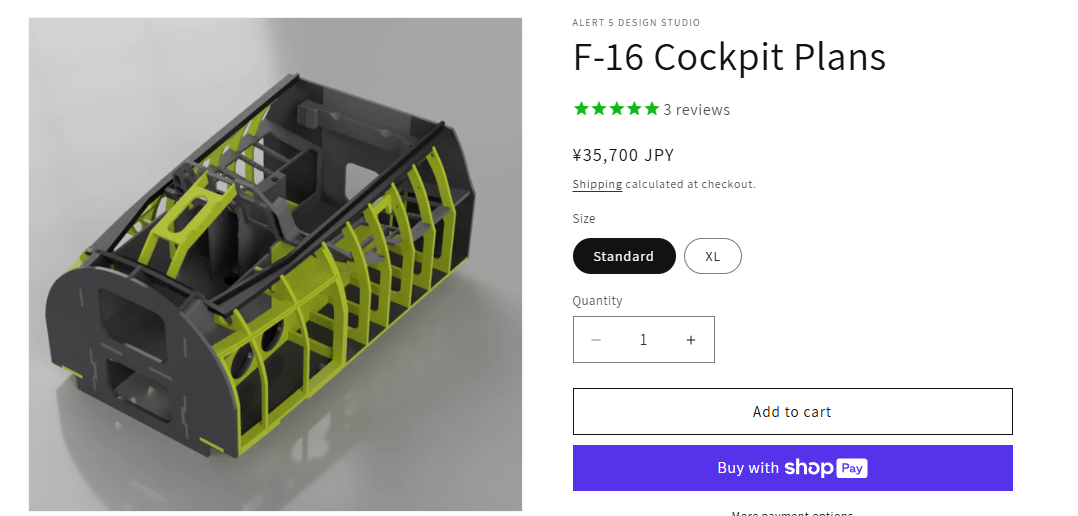
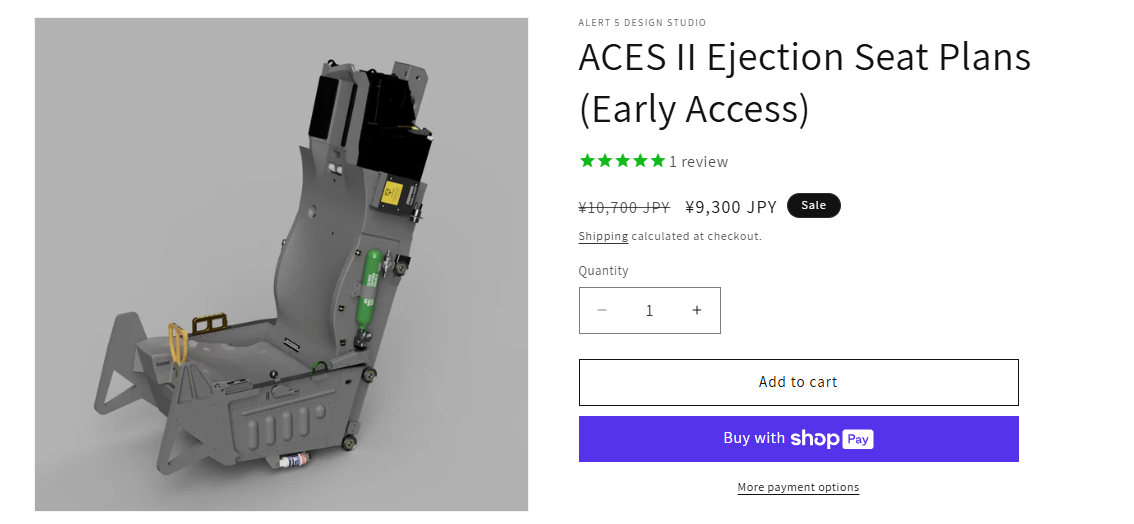
Also, I want to achieve the highest possible accuracy, so I would like to achieve an accuracy of at least ±0.5mm.
0.4mm or 0.3mm is fine.
I have a Maslow 4.1 CNC, but I can’t put a 12 x 8 foot frame in my room, so I need a Lowrider CNC that I can machine myself.
1 Like
Looks like a cool project. The LR4 will do the plywood and aluminium pieces easily. I don’t see anything there that needs such specific precision, though?
While it may not be a problem if it’s within 0.5mm on the outside of the frame, I am concerned that the position of the screw holes on the internal frame for attaching the panel may become misaligned.
Typically the tolerance for screw holes depends somewhat on the size of the screw. If this is being assembled with M3 screws etc. then usual allowance for misalignment would be in the ~0.5mm range.
You do not need 0.05mm for this, you’d likely be fine with 0.5mm and the LR4 will easily do better than that.
2 Likes
In that case, it seems that there will be no problem in using a low rider for my plan.
I will continue building the lowrider v4.
2 Likes
Totally doable in a Lowrider, the aluminum parts gets even better with the LR4 just follow the asembly instructions try to get perfectly straigh conduit and dont cut corners. (In the instructions i believe there is a link for the calibration of the 3d printer) That’s what will make things even better.
I mark my holes with a 1/16" drill bit, and just open them manually to the size they are needed most of the time when precision is a must.
Cool project! As stated above the lr4 will work perfect for this. Keep us updated on the project I’m curious to see how it turns out
1 Like
Absolutely awesome project! 0.5mm accuracy should defiantly be doable if you just double check square and everything. There should also be tolerances figured into the plans that can compound meaning you may not even need 0.5mm accuracy. watched a quick video from the engineer and seems very knowledgeable so I doubt you’ll have much of a issue. If you feel upto it share your build progress. Looks like a blast of a project, best of luck!
1 Like
You shouldn’t always be so stubborn. 
but accuracy should be openly resistant to inaccuracy, I mean this is the law of non-contradiction after all
(correct me if I am wrong but I remember you being a philosophy teacher)