As for the original post. It rings very true to me.
There is a serious shift in 3D printers and Bambu seems like the main catalyst. I think we can all feel it. There are people like Peter Brown on YT that are 3D printing now because they are supported by BL. Or the huge print farm from Unnecessary Inventions. And I hear from geeky friends and neighbors about it. And none of those people are tinkering or printing parts for their printers or designing improvements. It is a different culture, almost.
It makes sense to me that there is a larger force pushing things that way. But I don’t know how patents specifically affect that. To me, open source 3D printing (and the ability and desire to build or edit your own machine, the rep rap way) has lost the lead already. It has happened in front of us over the last 3 years. IDK how much patents or price manipulation or tariffs or shipping has affected any of this. From my perspective it is clearly a huge shift.
It was really fun building and designing these machines in the last 10 years. I know some people won’t ever give up. But I fear the days are numbered and we will end up like the HAM radio community in the future. Enjoying ourselves and slowly designing things we care about, but not able to grab the attention of newcomers and the next generation.
Either way, I’m not dead yet! I’m still going to be doing what grabs my obsession and spending my allowance on those obsessions.
I have a silly idea for a project at our new makerspace: Making a 3d printer with parts from a 2d-printer Seriously, I think it would pique some interest! (just like HAM projects also generate some interest within a selected crowd… )
Regarding Prusa - as a European, I’m happy to support a european business in the current global situation. The fact that they are trying their best to cater a tinker-minded audience, I also appreciate.
Jeff goes on to note that personal experiences shape this, so I’ll share some of mine.
I’ll also note that historically Prusa has been fairly open though is moving less so.
In my own case, I was aware early of the RepRap movement, and I played with some of the early RepRaps that used threaded rod. They were interesting, but frankly pretty horrible. While they could make their own parts just well enough to make more RepRaps, they were completely unsuitable for most functional parts. My attention waned.
Later, I discovered and became active at a local community makerspace that eventually grew quite large. We had a moderately large print farm which consisted of about a dozen Lulzbot AO-10X series printers. Lulzbot was at the time a local company here in Colorado, and the printers were (and still are to some degree) open. The printers in that print farm were donated by Lulzbot to our makerspace when Lulzbot was releasing the Taz series of printers, and they were replacing their factory full of AO-10X mules with the new Taz machines. They donated many, many AO-10x.
Lulzbot’s openness wasn’t just firmware or CAD. They shared their production BOMs, the gerbers, and the build notes. They released their factory tooling designs, and even their detailed manufacturing plans. You could literally fully recreate the product and the manufacturing facilities from these sources.
Some companies tried, in fact. I don’t think any succeeded because even with everything out there, the knowledge of how to actually run an enterprise and how to interact with a community isn’t something that you get from a design document.
Ultimately, Lulzbot went broke, and was sold eventually to the new owners who moved the company out of Colorado.
Here’s a key thing from that business failure: Lulzbot and the parent company Aelph Objects did not fail because they were open source. They failed because the leadership wasn’t very good at running a business.
There is more to it, including the fact that there was an emerging set of manufacturers in countries like China where the nation was willing to subsidize things like shipping costs or to run interference to make customs traversal easier. That is a challenge on a business, but it is just one of the stressors that impact the competitve environment.
We’ve talked about some of the others in this thread, like patent or copyright laws.
I’m one of those folks that will build my own stuff just because I want to know how to do it and want to show that even a schmuck like me can achieve it. (I also have an amateur radio license for what it’s worth ).
Here here.
I may yet buy a Core One or an XL, but in the course of writing this I’m reminded that I have most of the parts to put together an MP3DP V5 printer.
I’d now actually wait and see what the new MMU4 can do in a year or two. If it actually includes the Bondtech INDX it will be a lot better to just buy a Core One with an MMU4 or two instead of one XL. The XL seems to be their weakest link without a great enclosure etc.
My use case really screams at mixed materials instead of multi-color mono materials.
So, for example PLA and PETG are great support materials for each other, but if you run material changes with those materials through a single extruder you will wreck the material properties of the print and will also quickly make a mess of your extruder.
It just isn’t going to get there with an MMU, that needs a toolhead swap like the XL can do, or a multi-extruder toolhead like the Flashforge creator pro or Lulzbot Taz.
It’s actually why my first 3d printer was a prusa clone. The one I bought was all metal. Nothing was 3d printed on it. Modifcation required a hacksaw instead of just printing a new part.
I have a friend that is a lawyer in a patent office. They recently installed a bambu labs printer at the office for various reasons. Of course, the only thing he’s used it for so far was to 3d print an articulating dragon. (Looked really good btw)
To me, 3d printers have become an appliance at this point. And I don’t necessarily mind the fact the new companies to market are close sourcing their hardware. I do mind if they’re ganking software that was open source and trying to close source it. I just hope their parts replacement is as easy as me picking up new brake pads for my car. And that, I think, still requires time to decide how that goes.
I did look at a bambu labs printer at the store the other day. It’s really hard to not like what they’ve done there if your on the outside looking in. It really is only those of us that have been using printers since the beginning that knows anything behind the scenes.
This was my first RepRap 3D printer as well, and it was pretty bad. Mechanical parts were near impossible, even making 2 parts fit together required ridiculous tolerances.
I did hang around some.corners of the Internet where I.learned more about RepRap and Prusa, got info on Marlin and Slic3r, and started making stuff work with TinkerCad.
Prusa was always a bit rich for my budget, though that first printer cost me much more than my.most recent.
I’ve bought 3. That first one that was pretty bad. A plywood cube one that was much more.precise, but didnt come.with amenities like a heated build.platform, and finally the FlashForge A5M. The Flashforge is the only one I bought that I’ve been satisfied with.
I have had (and still have) several 3D printers aside from those. My second was one that I got plans for and self-sourced the parts, and it held together long enough to build my self-designed one, which made parts which were finally good enough for other things. It printed parts for my MP3DPv2 (gave to the kids), and MP3DPv3. The v3 printed parts for the LR3 and some.of the LR4 as well.as the v4, and the v4 printed the parts for a v5 (not yet assembled) and some of the LR4 the FlashForge came in somewhere in there and did much of the LR4 RC1 and RC2.
So this mostly kept me out of the Prusa camp, but also out of the BL camp. I think this gives me a pretty neutral viewpoint.
What I do have though, is a poor stance on Chinese IP respect. I’ve been involved with Chinese companies stealing design specs that they were paid to make and selling them off for a fraction of the cost to others. The design wasn’t open source, but the manufacturer charged a pretty steep “setup fee” for the first batch of units, then sold them to competing interests without that fee built in, making the first batch almost immediately unsellable.
I will probably never buy a Prusa, but I do have a lot of respect for what Prusa has done for the world of 3D printing.
I apologise for the firmness of my response I certainly did not intend the “tribal” implications that my reply contained! That’s exactly what I spend some time trying NOT to do!
I HAVE owned a number of Prusa printers and know some of the management team reasonably well, and cannot claim to be unbiased, but am also aware of the history and shortcomings. Thank you @jeffeb3 for your usual well balanced reply!
As noted above the question of copyright goes far beyond the 3d printing world, it’s about very strategic domination of key components of the manufacturing industry by an entire country. I have scoffed at some discussion of boycotting “Made in China”, because it’s simply not practicable or possible for the foreseeable future.
HOWEVER, I do support wherever I can the notion of “mostly made somewhere else” even if there is a premium to pay. If we want any kind of diversity of design and manufacturing in the future, I do believe we need to consider where we source our stuff.
Is it time for an “ethical business” badge instead of a patent?
China is a big place made up of a lot of individuals making daily decisions. So I refuse to think “China=Bad”. But when there are China-wide policies that negatively affect real innovation (like a subsidy for patents), that makes me want to move away from the country alltogether. It isn’t really possible these days. But I do get good feelings when I see something is made in the US.
In fairness to Bambu, here’s my two cents on them as a newcomer:
So I had always heard of 3D printers and knew people who had them back in like 2014-15, all you ever heard was how the hobby is actually taking care of a printer instead of actually printing. My friend got one in 2022 and even that one has him always complaining about how often it goes down.
The 3DP world was begging for an Apple type “affordable luxury, it just works” company, and Bambu stepped in. Just look around at “what printer should I buy?” threads online and so many responses now are “just get a Bambu and have fun”… I went to microcenter, bought an A1 AMS combo for $550 and the LR4 core was like the 3rd thing I’d ever printed, it came out perfect and I checked in on it at work via their nice app and built in web cam. And the app?? Genius. They have contests all the time for people to submit their models, winners get hundreds in Bambu gift cards. So they always have new stuff and it’s usually relevant to the season/holiday/big event, and then the app has a social media type aspect with comments, likes, remixes, profiles, etc.
All this to say, from an ignorant fool who just wanted his new toy to work well and not be a time sink… I don’t see anything being better than the Bambu experience? I mean just look at all the features of the H2D, you can get a laser that cuts 15mm plywood dawg, with auto beam calibration, with an air filter for the exhaust… the lidar scans your material so you can put scrap wood in it of some crazy shape, scan it, and then it’ll auto arrange your cut files into the most space efficient setup… https://bambulab.com/en-us/h2d
Disclaimer: I literally do not see the news or any advertisements on any of my devices anymore so Bambu could be hitler 2.0 and I wouldn’t know so go easy on me if my blissful ignorance causes me to cross a line lol
Not to start a debate, but prusa was giving that experience before bambu. And there were companies like ultimaker in the decade before that. Ultimaker was always very very expensive (10-20x what I paid for my hobby printer). Prusa was also pretty expensive (2-3x what I paid for my hobby printer). Bambu is about the same price as prusa now and both are more expensive than a hobby printer.
There has always been that experience of being able to just open the box and start printing. It used to be much more expensive. Bambu hasn’t invented that and 98% of the features in a bambu printer were there before. The contests and app you’re talking about are basically clones of printables (by prusa) which were modeled and refined from thingiverse.
The big difference to bambu from the previous ones is the closed source and the intense marketing. So many more influencers have been given bambu printers. They are good quality and they have earned their reputation. But the volume of the recommendations is driven by the marketing department.
I understand all that, but it still doesn’t negate the fact that the market was begging for someone like them… They need not do anything first, much like Apple (how many years did it take for iPhone to get copy/paste and a camera with a flash??), they just needed to do it better than everyone else. The A1 mini’s went for like $175 at some point, it’s hard to be more accessible than that for such high quality, y’know?
I also don’t understand the closed source part, what hardware innovations does Bambu make that they keep as a trade secret? I am legitimately curious as to the hate, not trying to be a smartass. Software wise, MakerWorld is free for anyone to join and use and all models can be downloaded in all the major file types, plus they actually do uphold licenses/remix policies, and allow avenues for creators to go commercial and make serious money.
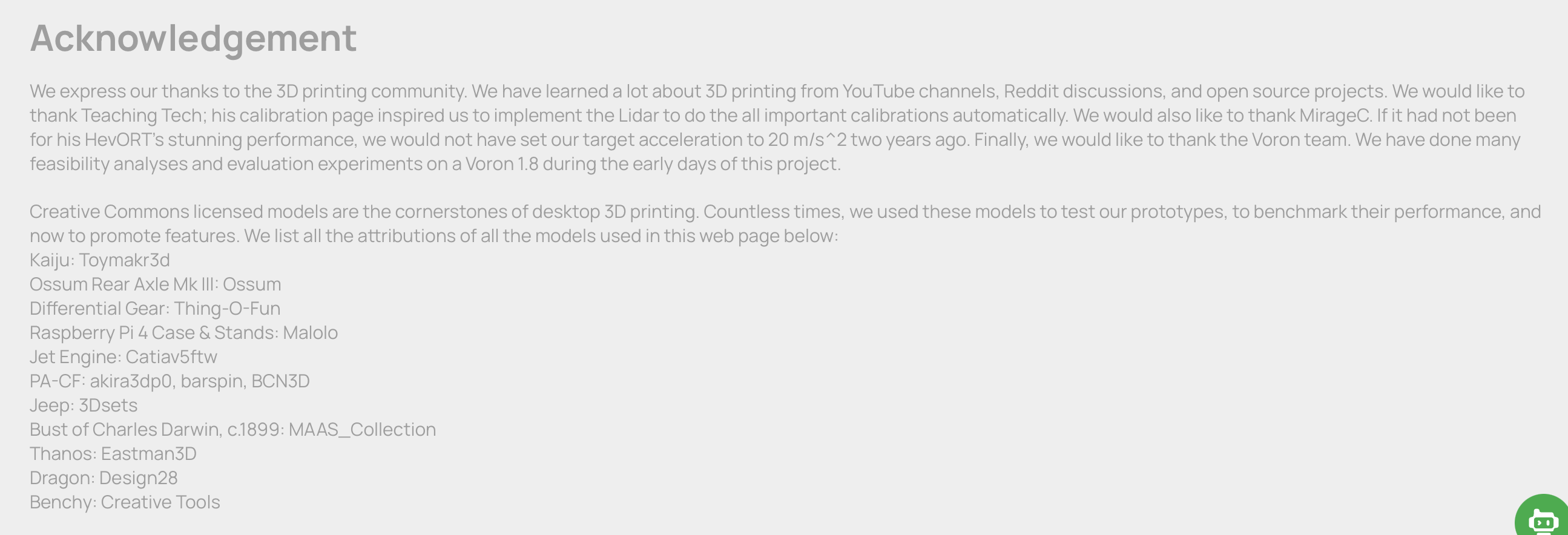
Also see their advertisement page for the X1C, they have a pretty long list of acknowledgements to the community and sounds like they were collaborative? https://bambulab.com/en-us/x1
So is Prusa selling for below cost, too, like he’s complaining about Bambu doing?
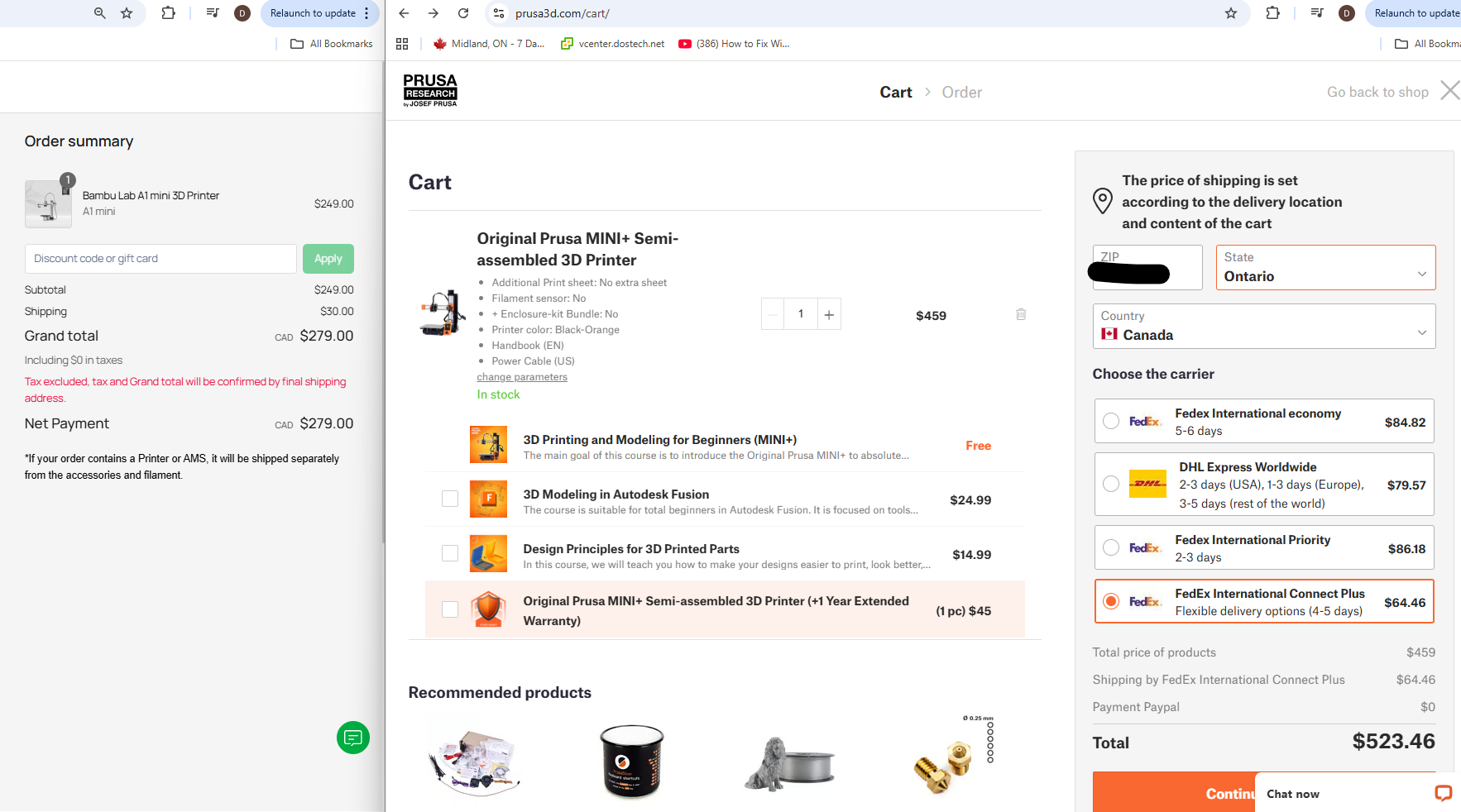
I hadn’t done any 3D printing since 2005 (mostly metal then), and when I went to buy a printer last April, I was about to buy a Prusa… had one in the checkout cart, and it wasn’t until PayPal asked to confirm the amount and pointed out (unlike the Prusa website) that it was in US funds I took pause and looked for a less expensive option. I ended up getting a Bambu Lab printer for way less than half the price of a Prusa (and all of the models were that way).
Looking right now, it still looks like a mini (which you can do a heck of a lot with) is still way less than half the price Bambu vs. Prusa. $279 plus tax vs $743 plus tax ($523.46 US * 1.39 exchange rate + 3% exchange fees).
I would love to try a Prusa. How do you get them for half the price? I didn’t go with Bambu for features or “ready to print out of the box”…. the Prusa was just too damn expensive, and still looks to be.
And that’s insanely high. In Germany I’d pay 1400€ including shipping, that’s roughly $1630. Your problems are the tariffs, the crashing dollar and the shipping. Prusa was working at a foothold in the US, don’t know how far that got with everything happening.
I am pretty sure Bambu has got a loophole to evade the tariffs somehow? Not sure though, just throwing it out.
If your Prusa breaks (which it barely does), you can either print the replacement part, because the printed parts are Open Source or buy the part (the boards etc. are pretty closed, but you can just buy them). Also, the Prusas are build with serviceability in mind. I can completely disassemble my printer if I want to, since Prusa grew from the RepRap movement. Bambu didn’t, they are streamlined customer products (and the Apple comparison is fitting, can’t really build an Apple Yourself or repair it, but building and repairing Linux or Windows machines is easy). If your Bambu breaks: good luck.
Your discussion is no different than the Android vs iPhone or Windows vs Mac. And it’s actually a very good comparison for similar reasons.
Bambu built on the knowledge and experience of everyone else. Created a machine that works really well. And then locked down all the knowledge of that machine so if anything happens to it you have to go back to them to get the parts. What happens in 3 years when the P1S is no longer being sold? Are all of the previously sold printers now paperweights if something breaks?
As mentioned previously, I built my first machine 2015-ish and it’s been modified and updated 3 times since then. It’s on it’s 3rd controller, second heated bed assembly, and second print head. Are you going to be able to do that with the bambu printers?
Like you alluded to. The Bambu is an appliance. And that’s where I think all the hobbyists are rubbed the wrong way. We lived through the teething times of 3d printing.
I think it fits in with the hot-rodders mantra of “built not bought”
With that being said, Bambu does make a great product and they do have an amazing marketing team. I do have to roll my eyes every time I see a new maker on YouTube suddenly have a P1S or X1C in their shop and suddenly start printing parts for projects that they would have previously milled. But I can’t fault them for that. I use my printer a lot for testing fitting parts before making the part out of other materials too.
Uh, no, 1400€ would be $2258 in Canadian dollars. Looks like you’d pay 16% more than my $1941 while being waaaay closer to Ukraine Czech Republic. That’s insane.
No tariffs on these sorts of products from Ukraine Czech Republic or China. Our dollar is around historical levels, and shipping is about $90, and included in the $1941.
 Seriously, I think it would pique some interest! (just like HAM projects also generate some interest within a selected crowd… )
 ).
).