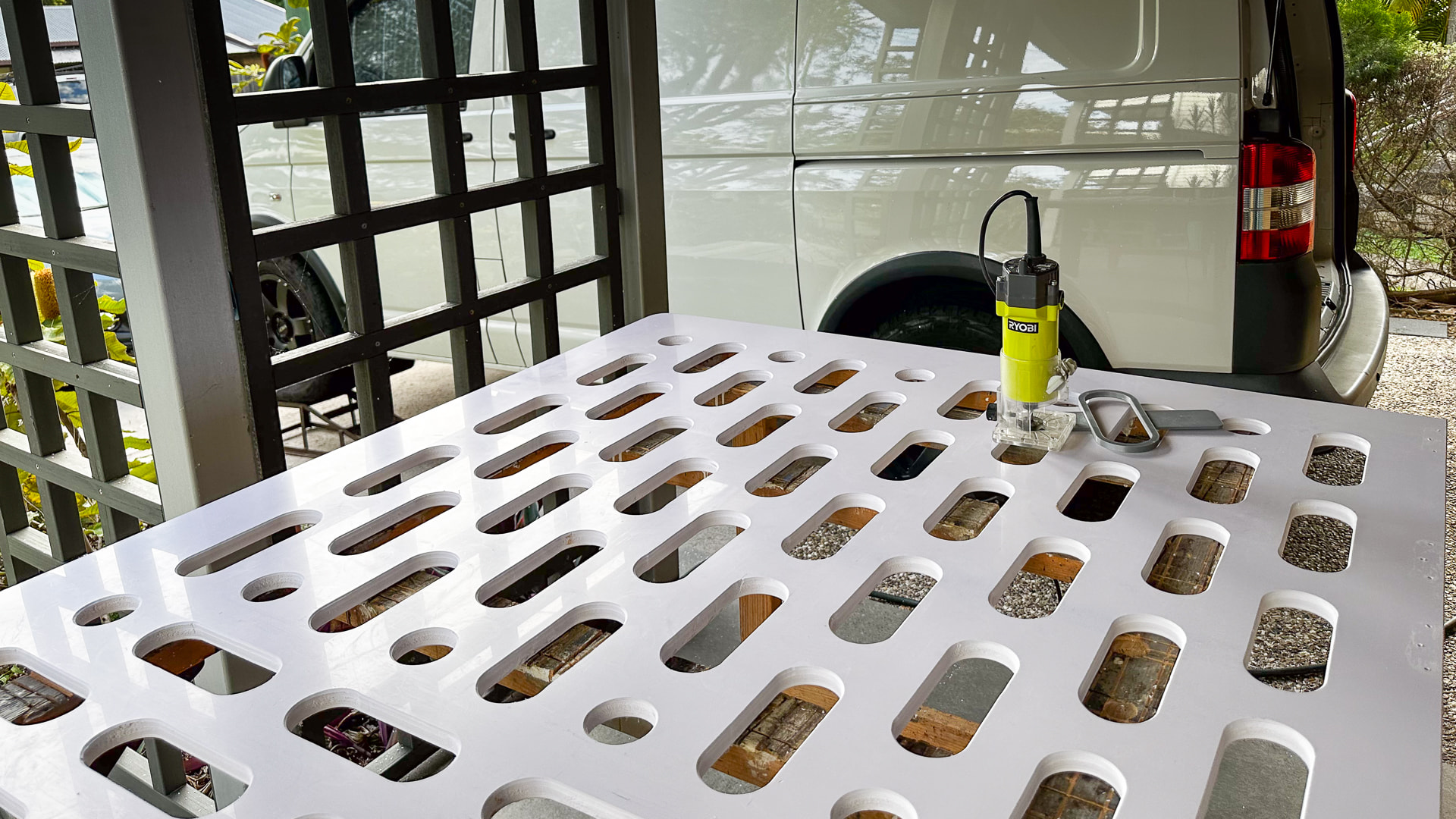
Incredible…though…the 3d printed jigs on the table saw scare me just a little.
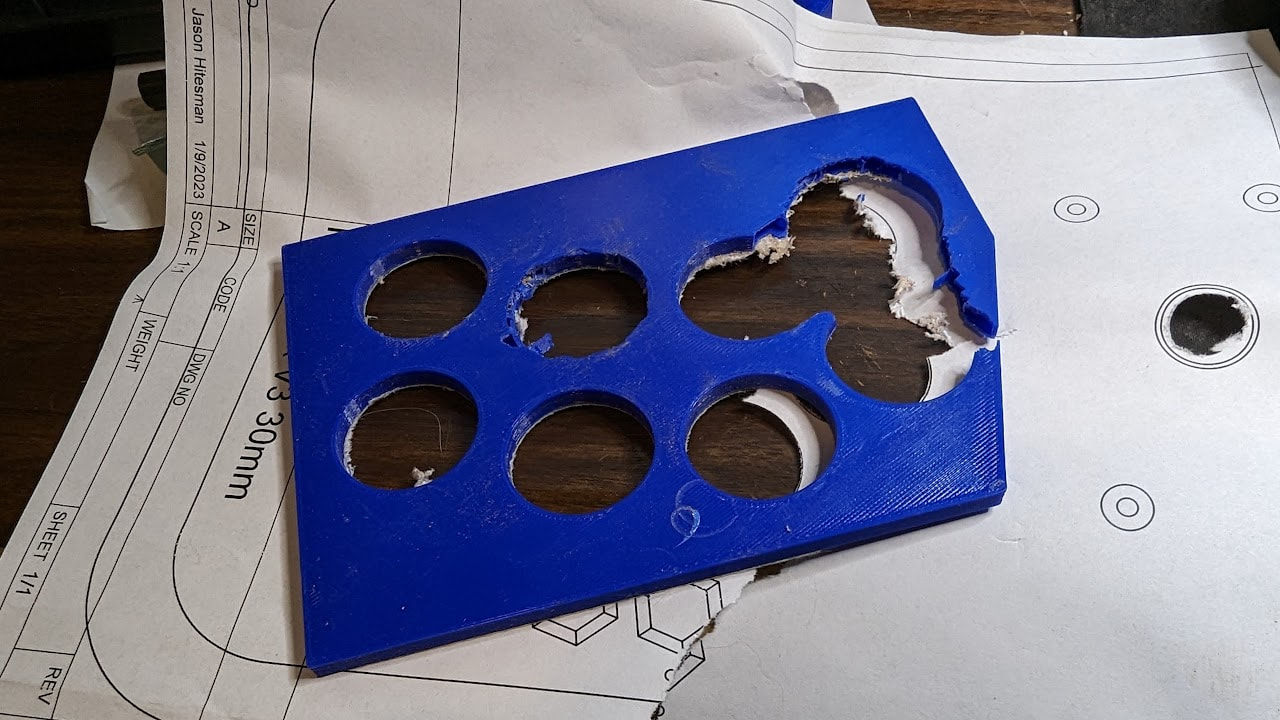
I used a 3d printed jig with a router to make a test layout for a MAME controller - which worked great…until I set the depth of the router slightly wrong and the bit hit the jig instead of the bearing hitting the jig:
The print practically exploded when it got nicked by the bit. Scared the heck out of me and ruined the piece.
I’ve still done it again since…but I’ve used way more walls on the prints and am much more careful about making sure the router can’t touch the template at all
I use PLA jigs for everything, (I have a similar drawer full of hand-cut MDF ones) because there’s no point in wearing out the CNC! I am pretty sure @Fabien uses a similar method - zero top and bottom layers, half a dozen perimeters - super fast to print, and make them slightly deeper than the bearing. I use an extra top or bottom layer if for some reason they have to be super rigid (like assembly clamping fixtures). Some of these are simply to locate screw holes or fixtures, mostly they are quick.
I still maintain that many jobs are easier with templates and hand work than directly CNC. The table build above is an extreme example, I don’t see much that a CNC router would have helped with.
Personally, once I get around to tearing down the MPCNC and building up an LR of some kind, I’m going to keep it small and larger projects will be done using the smaller machine to cut a template that I can jigsaw together.
Personally, I’d rather do a top/bottom shell for the shear strength, hit it with a palm sander for 10s if needed and then have it out of PETG which will cut/melt rather than fracture. I can’t remember the exact scenario but I’ve had PLA shatter and send chunks flying before.
Obviously none of that’s needed if you just never snag the jigs with the bit but I’m a little more risk averse than that!
I have melted a couple of edges after many dozens of passes - mostly drilling jigs, which is understandable. The structure depends on the use - heavier with multiple repetitions need more, and also with the load of course… and I have done a few repeat cuts over the years! (Jig is beside the router)
Sadly at the time my MPCNC wasn’t really an option. I couldn’t be out in the shop with it long enough to do anything and it had become a storage place with enough junk piled on it just clearing it off would have taken longer than printing the jig
It was PLA - I was very low on PETG and figured PLA would be ok since it was a single use and there shouldn’t have been much force acting on the PLA. I just didn’t plan on misadjusting the height and hitting it with the cutting edge.
And yeah - this particular job I probably would have used the CNC if it was available at the time. But there are still plenty of cases were I’d rather use a quick jig than generate gcode and setup the machine for a one off.
I love having options - being able to pick and choose tools to fit the task is key
That’s weird, definitely 3D printed PETG? I’ve got a couple of printed pieces of press tooling that weren’t quite right and deformed under a few hundred kg from the arbor press rather than shattering… I’ve got half a dozen net pots here that I’ve printed in both PLA and PETG and the PETG ones flex until they deform while the PLA ones crack violently…
Yep definitely PETG - printed when I thought it was the definition of exotic material! One was a tool handle for a heavy bar, tap-fit and printed solid (I used to set 99 perimeters to be sure). I dropped it on concrete and it just flew into a bunch of little shards.
On the other hand, I’ve just had some four year old silk pla prints disintegrate! It was awful filament at the time, with dodgy adhesion, but I built some shelf supports with it anyway, and they’ve just fallen apart - I can crumble them in my arthritic old hands! It was just that batch, and fortunately I only made a few things with it before returning it to the manufacturer.
You folks hear about Super Wood yet? A buddy told me about it and it’s got me nerding out, it’s real life sci-fi!
They use chemicals to remove all the lignin from the wood and then compress it down until the cellulose forms hydrogen bonds with itself. End result is wood that is stronger than steel! Even cooler, it was discovered while trying to make transparent wood!
Another one, significantly less neat than Super Wood lol. Have we all been over thinking vacuum tables? This thing is just a single hose that goes into a bench dog hole and provides enough suction to hold a workpiece down. I saw it in a YouTube vid, it seemed to work great!
I ain’t paying money for it, but it does seem DIY-able