MPCNC Compact?

MPCNC Compact – Community Project Idea

I’ve been thinking about a new MPCNC-style machine and wanted to throw the idea out here as a community project, rather than as a finished design of my own.

Working name idea MPCNC Compact?

The idea is to develop a new machine within the MPCNC spirit: low-cost, DIY-friendly, mostly 3D printed, built from common parts, and fully open source. My hope is that this could become something we develop together as a community, with different people contributing ideas, CAD, mechanics, electronics, firmware, testing and improvements.

The basic concept is a small central CNC body with a 65 mm router/Z-axis in the middle and four vertical NEMA17 motors around it. Each motor would control a GT2 belt running out to an anchor point at the corner of the work area. The belts could be pulled out manually during setup and hooked to fixed anchors around the spoilboard.

Where possible, it could reuse typical MPCNC-style parts such as NEMA17 motors, electronics, belts, pulleys and Z-axis components, while the rest would be a completely new compact body, mainly 3D printed around an aluminium base plate.

The goals would be:

  • very small storage footprint
  • no large permanent frame
  • scalable work area
  • potentially capable of full-sheet work
  • low-cost and DIY-friendly
  • common and easily sourced parts
  • fully open source
  • designed and developed collaboratively by the MPCNC community

This is only an initial concept. I’m not attached to any particular mechanical solution, and I definitely don’t expect to design the whole machine myself. The belt routing, tensioning, kinematics, calibration, firmware and overall geometry are all open questions.

The idea is simply to put MPCNC Compact on the table and see whether enough people find it interesting to turn it into a real community-built MPCNC machine.

If people are interested, I’d love to see everyone throw in ideas, sketches, calculations, criticism, CAD concepts or whatever they can contribute.

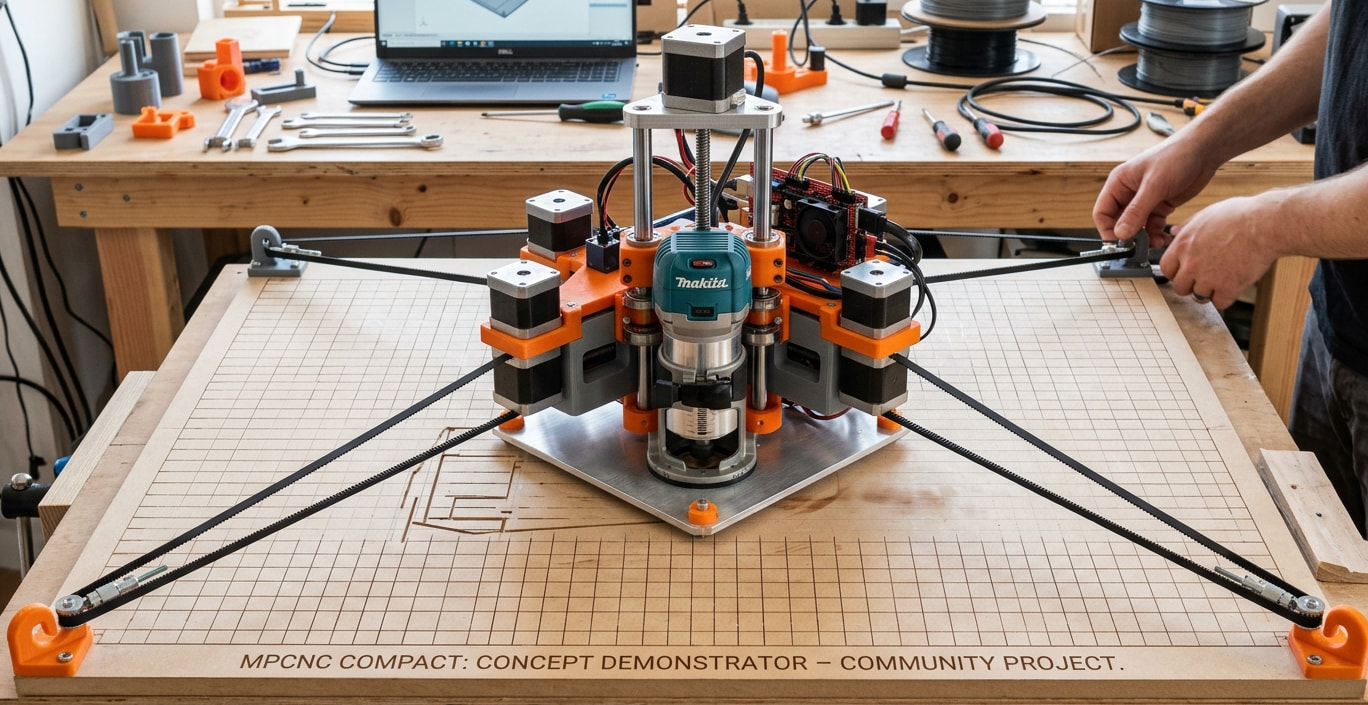
One more Idea. Yes I have used AI to create the pictures

That is pretty much a Maslow CNC, https://www.maslowcnc.com/

There was also a https://www.kickstarter.com/projects/2130625347/goliath-cnc-an-autonomous-robotic-machine-tool-for

As Ryan has stated that does not fall in line with his machines. But I see one real problem, how do you get what you cut under it? That is why maslow uses gravity and only 2 points of attachment

I can;t find it but I know there was another cnc that sort of looked like that. driving me nuts

Gordix maybe?

Yep, you’re right — after looking more closely at Maslow 4, the basic kinematics are very similar.

What I’m wondering now is whether there could be an MPCNC-style version of the concept, built around the parts many of us already use: NEMA17 steppers, GT2 belts, inexpensive controllers and mostly 3D-printed components.

So rather than trying to reinvent Maslow, maybe MPCNC Compact could be a community experiment to see how simple and inexpensive this type of machine could be made using the MPCNC ecosystem.

I’m mainly throwing the idea out there to see where the community takes it — I definitely don’t have a finished mechanical solution in mind.

100%!!

It would be fun to experiment but there is a few tradeoffs to not using rails of any kind.

Two criticism I have are:

  1. The software and kinematics are going to be very hard. This is very different than the XYZ of a cartesian machine. The Maslow had a lot of focus and effort from their kickstarter to get going and the v1 was pretty bad anywhere near the corners. You will definitely want to reuse as much of that system as you can. Reinventing the wheel is not fun as a community project.
  2. The term MPCNC means something very specific. If it isn’t a trademark of V1E, it should be. Call it a “tornado” or “4 ring circus” or “Quadtopus” and you will be able to go wherever you want without the conflict or confusion of connecting to the MPCNC.

I was really excited when I thought it was a compact MPCNC, but this is an entirely different beast. I really dislike the AI drawings, because I was excited to see how you solved problems like the extra belts when you got close to a corner.

It would be a really fun project to work on. IMHO, what you have to do is just start it. You will get plenty of naysayers (myself included, looking at this post) early on. But you will get real contributors and even more naysayers when you start making some objects move around the bench.

… nevermind…

Oops, there were already answers that basically said the same. :sweat_smile:

We’ve got a Maslow 4.1.

First issue with your idea is the flexibility of the GT belts. They stretch. The maslow uses a reinforced belt.

Second issue with these machines is that they need the workpiece to lay on. You can never cut something small from a small piece of material you have lying around. We played with it, but it’s very unpractical.

Lastly, if you want to develop a machine like this, head over to the Maslow community and help out there with further development instead of reinventing the wheel here.

GT2 belts are almost all reinforced. Either wirh fiber or with steel. We don’t use the steel ones because they break after many tight bends. So anything from a voron to a low rider use fiber reinforced belts and the stretch is either negligible, or can be calibrated for.

The amount of tension our Maslow needs on the belts is quite high, but maybe it’s true the stretch is negligible. The Maslow’s aren’t very precise to begin with… :pensive_face:

I actually tested some steel-reinforced belts vs our fiber ones, Suprisingly I still got a lot of stretch. The longer the belts the more that comes into play, small machines it is small enough that it is hard to measure. 9’ and it is there for sure.